

282
R. Forty and O. Ullaland
3σ PID detector length [m]
10
1
10 3
10 2
10
p [GeV/c]
1
TOF
FWHM = 100 ps
Liquid/solid
Aerogel
Gases
Rich
TR + dE/dx
dE/dx
10
–1
10
–2
10
–1
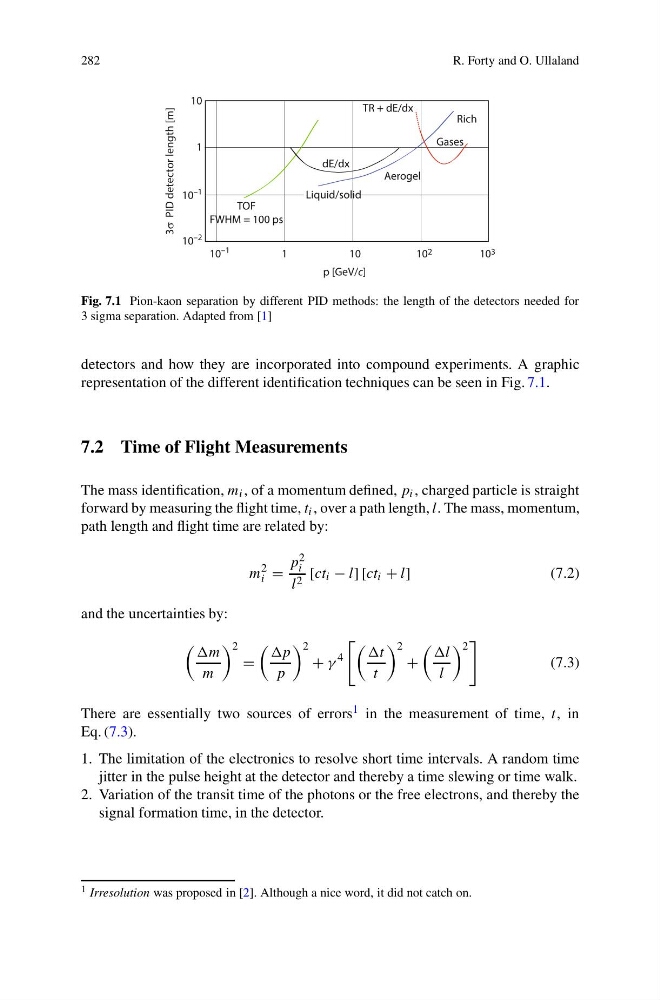
Fig. 7.1 Pion-kaon separation by different PID methods: the length of the detectors needed for
3 sigma separation. Adapted from [1]
detectors and how they are incorporated into compound experiments. A graphic
representation of the different identification techniques can be seen in Fig. 7.1.
7.2 Time of Flight Measurements
The mass identification, m i , of a momentum defined, p i , charged particle is straight
forward by measuring the flight time, t i , over a path length, l. The mass, momentum,
path length and flight time are related by:
m
2
i =
p 2
i
l 2 [ct i − l] [ct i + l]
(7.2)
and the uncertainties by:
m
m
2
=
p
p
2
+ γ
4
t
t
2
+
l
l
2
(7.3)
There are essentially two sources of errors 1 in the measurement of time, t, in
Eq. (7.3).
1. The limitation of the electronics to resolve short time intervals. A random time
jitter in the pulse height at the detector and thereby a time slewing or time walk.
2. Variation of the transit time of the photons or the free electrons, and thereby the
signal formation time, in the detector.
1 Irresolution was proposed in [2]. Although a nice word, it did not catch on.
R. Forty and O. Ullaland
3σ PID detector length [m]
10
1
10 3
10 2
10
p [GeV/c]
1
TOF
FWHM = 100 ps
Liquid/solid
Aerogel
Gases
Rich
TR + dE/dx
dE/dx
10
–1
10
–2
10
–1
Fig. 7.1 Pion-kaon separation by different PID methods: the length of the detectors needed for
3 sigma separation. Adapted from [1]
detectors and how they are incorporated into compound experiments. A graphic
representation of the different identification techniques can be seen in Fig. 7.1.
7.2 Time of Flight Measurements
The mass identification, m i , of a momentum defined, p i , charged particle is straight
forward by measuring the flight time, t i , over a path length, l. The mass, momentum,
path length and flight time are related by:
m
2
i =
p 2
i
l 2 [ct i − l] [ct i + l]
(7.2)
and the uncertainties by:
m
m
2
=
p
p
2
+ γ
4
t
t
2
+
l
l
2
(7.3)
There are essentially two sources of errors 1 in the measurement of time, t, in
Eq. (7.3).
1. The limitation of the electronics to resolve short time intervals. A random time
jitter in the pulse height at the detector and thereby a time slewing or time walk.
2. Variation of the transit time of the photons or the free electrons, and thereby the
signal formation time, in the detector.
1 Irresolution was proposed in [2]. Although a nice word, it did not catch on.