

268
C. W. Fabjan and D. Fournier
0
110
Data
S+B Fit
B Fit Component
±1 σ
±2 σ
120
130
140
120
1000
1500
Events/ 1.5 GeV
130
Unweighted
150
m γγ (GeV)
m γγ (GeV)
500
S/(S+B) Weighted Events / 1.5 GeV
1000
1500
CMS √s = 7 TeV, L = 5.1 fb –1 √s = 8 TeV, L = 5.3 fb –1
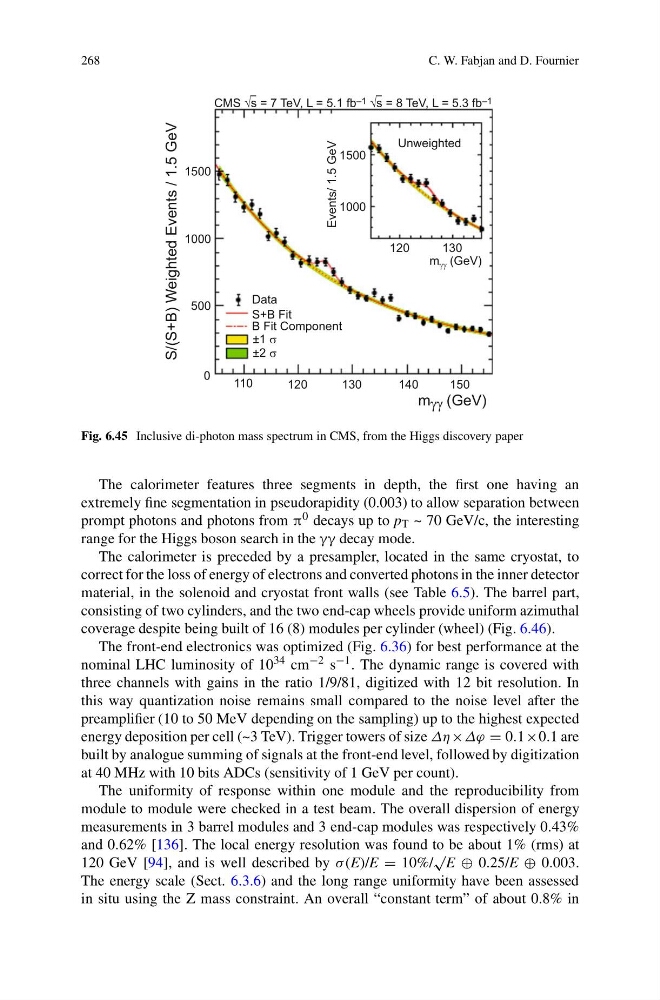
Fig. 6.45 Inclusive di-photon mass spectrum in CMS, from the Higgs discovery paper
The calorimeter features three segments in depth, the first one having an
extremely fine segmentation in pseudorapidity (0.003) to allow separation between
prompt photons and photons from π 0 decays up to p T ~ 70 GeV/c, the interesting
range for the Higgs boson search in the γγ decay mode.
The calorimeter is preceded by a presampler, located in the same cryostat, to
correct for the loss of energy of electrons and converted photons in the inner detector
material, in the solenoid and cryostat front walls (see Table 6.5). The barrel part,
consisting of two cylinders, and the two end-cap wheels provide uniform azimuthal
coverage despite being built of 16 (8) modules per cylinder (wheel) (Fig. 6.46).
The front-end electronics was optimized (Fig. 6.36) for best performance at the
nominal LHC luminosity of 10 34 cm −2 s −1 . The dynamic range is covered with
three channels with gains in the ratio 1/9/81, digitized with 12 bit resolution. In
this way quantization noise remains small compared to the noise level after the
preamplifier (10 to 50 MeV depending on the sampling) up to the highest expected
energy deposition per cell (~3 TeV). Trigger towers of size Δη×Δϕ = 0.1×0.1 are
built by analogue summing of signals at the front-end level, followed by digitization
at 40 MHz with 10 bits ADCs (sensitivity of 1 GeV per count).
The uniformity of response within one module and the reproducibility from
module to module were checked in a test beam. The overall dispersion of energy
measurements in 3 barrel modules and 3 end-cap modules was respectively 0.43%
and 0.62% [136]. The local energy resolution was found to be about 1% (rms) at
120 GeV [94], and is well described by σ (E)/E = 10%/
√
E ⊕ 0.25/E ⊕ 0.003.
The energy scale (Sect. 6.3.6) and the long range uniformity have been assessed
in situ using the Z mass constraint. An overall “constant term” of about 0.8% in
C. W. Fabjan and D. Fournier
0
110
Data
S+B Fit
B Fit Component
±1 σ
±2 σ
120
130
140
120
1000
1500
Events/ 1.5 GeV
130
Unweighted
150
m γγ (GeV)
m γγ (GeV)
500
S/(S+B) Weighted Events / 1.5 GeV
1000
1500
CMS √s = 7 TeV, L = 5.1 fb –1 √s = 8 TeV, L = 5.3 fb –1
Fig. 6.45 Inclusive di-photon mass spectrum in CMS, from the Higgs discovery paper
The calorimeter features three segments in depth, the first one having an
extremely fine segmentation in pseudorapidity (0.003) to allow separation between
prompt photons and photons from π 0 decays up to p T ~ 70 GeV/c, the interesting
range for the Higgs boson search in the γγ decay mode.
The calorimeter is preceded by a presampler, located in the same cryostat, to
correct for the loss of energy of electrons and converted photons in the inner detector
material, in the solenoid and cryostat front walls (see Table 6.5). The barrel part,
consisting of two cylinders, and the two end-cap wheels provide uniform azimuthal
coverage despite being built of 16 (8) modules per cylinder (wheel) (Fig. 6.46).
The front-end electronics was optimized (Fig. 6.36) for best performance at the
nominal LHC luminosity of 10 34 cm −2 s −1 . The dynamic range is covered with
three channels with gains in the ratio 1/9/81, digitized with 12 bit resolution. In
this way quantization noise remains small compared to the noise level after the
preamplifier (10 to 50 MeV depending on the sampling) up to the highest expected
energy deposition per cell (~3 TeV). Trigger towers of size Δη×Δϕ = 0.1×0.1 are
built by analogue summing of signals at the front-end level, followed by digitization
at 40 MHz with 10 bits ADCs (sensitivity of 1 GeV per count).
The uniformity of response within one module and the reproducibility from
module to module were checked in a test beam. The overall dispersion of energy
measurements in 3 barrel modules and 3 end-cap modules was respectively 0.43%
and 0.62% [136]. The local energy resolution was found to be about 1% (rms) at
120 GeV [94], and is well described by σ (E)/E = 10%/
√
E ⊕ 0.25/E ⊕ 0.003.
The energy scale (Sect. 6.3.6) and the long range uniformity have been assessed
in situ using the Z mass constraint. An overall “constant term” of about 0.8% in