

6 Calorimetry
267
Crystals in a
supermodule
Preshower
Supercrystals
Modules
Preshower
End-cap crystals
Dee
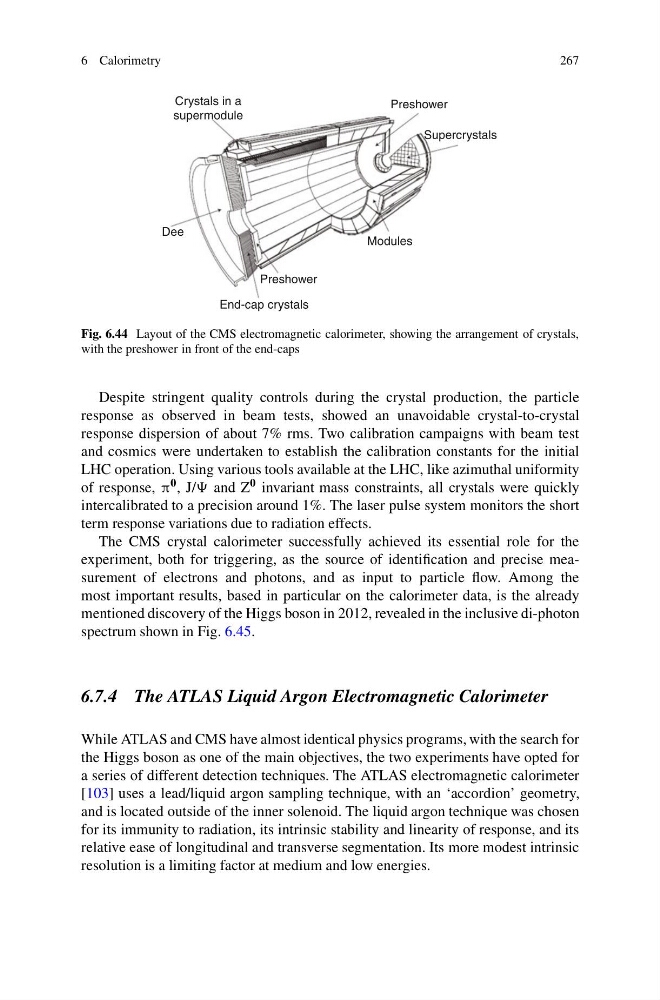
Fig. 6.44 Layout of the CMS electromagnetic calorimeter, showing the arrangement of crystals,
with the preshower in front of the end-caps
Despite stringent quality controls during the crystal production, the particle
response as observed in beam tests, showed an unavoidable crystal-to-crystal
response dispersion of about 7% rms. Two calibration campaigns with beam test
and cosmics were undertaken to establish the calibration constants for the initial
LHC operation. Using various tools available at the LHC, like azimuthal uniformity
of response, π 0 , J/ and Z 0 invariant mass constraints, all crystals were quickly
intercalibrated to a precision around 1%. The laser pulse system monitors the short
term response variations due to radiation effects.
The CMS crystal calorimeter successfully achieved its essential role for the
experiment, both for triggering, as the source of identification and precise measurement of electrons and photons, and as input to particle flow. Among the
most important results, based in particular on the calorimeter data, is the already
mentioned discovery of the Higgs boson in 2012, revealed in the inclusive di-photon
spectrum shown in Fig. 6.45.
6.7.4 The ATLAS Liquid Argon Electromagnetic Calorimeter
While ATLAS and CMS have almost identical physics programs, with the search for
the Higgs boson as one of the main objectives, the two experiments have opted for
a series of different detection techniques. The ATLAS electromagnetic calorimeter
[103] uses a lead/liquid argon sampling technique, with an ‘accordion’ geometry,
and is located outside of the inner solenoid. The liquid argon technique was chosen
for its immunity to radiation, its intrinsic stability and linearity of response, and its
relative ease of longitudinal and transverse segmentation. Its more modest intrinsic
resolution is a limiting factor at medium and low energies.
267
Crystals in a
supermodule
Preshower
Supercrystals
Modules
Preshower
End-cap crystals
Dee
Fig. 6.44 Layout of the CMS electromagnetic calorimeter, showing the arrangement of crystals,
with the preshower in front of the end-caps
Despite stringent quality controls during the crystal production, the particle
response as observed in beam tests, showed an unavoidable crystal-to-crystal
response dispersion of about 7% rms. Two calibration campaigns with beam test
and cosmics were undertaken to establish the calibration constants for the initial
LHC operation. Using various tools available at the LHC, like azimuthal uniformity
of response, π 0 , J/ and Z 0 invariant mass constraints, all crystals were quickly
intercalibrated to a precision around 1%. The laser pulse system monitors the short
term response variations due to radiation effects.
The CMS crystal calorimeter successfully achieved its essential role for the
experiment, both for triggering, as the source of identification and precise measurement of electrons and photons, and as input to particle flow. Among the
most important results, based in particular on the calorimeter data, is the already
mentioned discovery of the Higgs boson in 2012, revealed in the inclusive di-photon
spectrum shown in Fig. 6.45.
6.7.4 The ATLAS Liquid Argon Electromagnetic Calorimeter
While ATLAS and CMS have almost identical physics programs, with the search for
the Higgs boson as one of the main objectives, the two experiments have opted for
a series of different detection techniques. The ATLAS electromagnetic calorimeter
[103] uses a lead/liquid argon sampling technique, with an ‘accordion’ geometry,
and is located outside of the inner solenoid. The liquid argon technique was chosen
for its immunity to radiation, its intrinsic stability and linearity of response, and its
relative ease of longitudinal and transverse segmentation. Its more modest intrinsic
resolution is a limiting factor at medium and low energies.