

6 Calorimetry
265
muons. The liquid Xenon calorimeter is kept, but the PMTs are replaced by VUV
sensitive SiPMs, with a size of 12 × 12 mm 2 , in order to improve the photon energy
and position resolution. The prospect is to reach a sensitivity of 5 10 −14 [134].
6.7.2 The Xenon 1T Experiment
Xenon1T is the largest and most recent detector of a generation of xenon detectors
optimized for the detection of nuclear recoils of very low energy (below 100 keV),
as could be produced by the scattering of a WIMP on nuclei (xenon in this case).
Observation of such recoils, if they were to be produced, requires high accuracy of
the energy measurement and very low background. The detector, operated as a dual
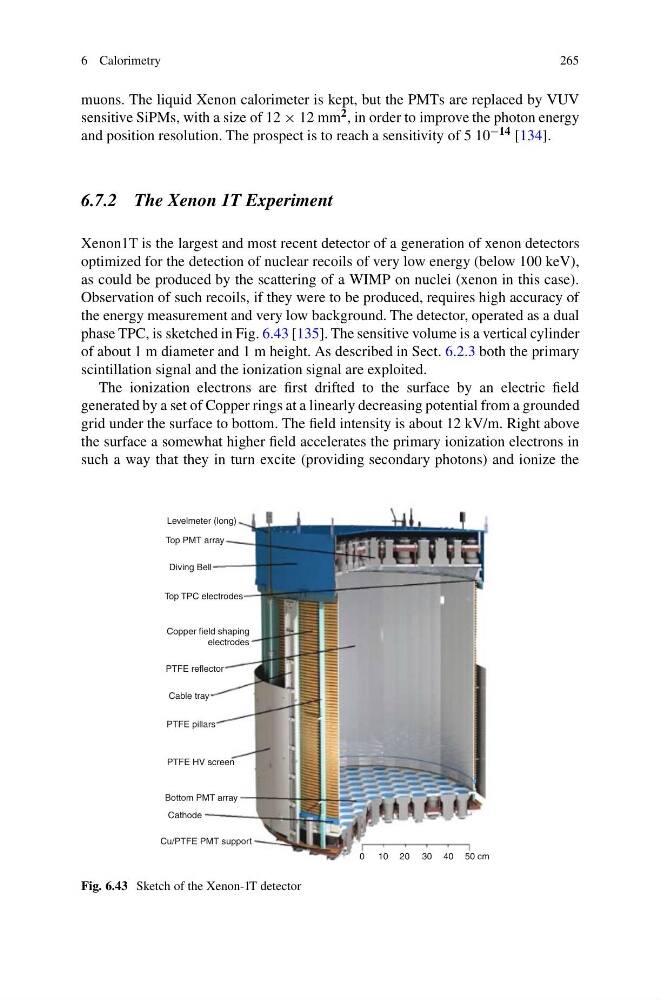
phase TPC, is sketched in Fig. 6.43 [135]. The sensitive volume is a vertical cylinder
of about 1 m diameter and 1 m height. As described in Sect. 6.2.3 both the primary
scintillation signal and the ionization signal are exploited.
The ionization electrons are first drifted to the surface by an electric field
generated by a set of Copper rings at a linearly decreasing potential from a grounded
grid under the surface to bottom. The field intensity is about 12 kV/m. Right above
the surface a somewhat higher field accelerates the primary ionization electrons in
such a way that they in turn excite (providing secondary photons) and ionize the
Levelmeter (long)
Top PMT array
Diving Bell
Top TPC electrodes
Copper field shaping
electrodes
PTFE reflector
Cable tray
PTFE pillars
PTFE HV screen
Bottom PMT array
Cathode
Cu/PTFE PMT support
0
10 20 30 40 50 cm
Fig. 6.43 Sketch of the Xenon-1T detector
265
muons. The liquid Xenon calorimeter is kept, but the PMTs are replaced by VUV
sensitive SiPMs, with a size of 12 × 12 mm 2 , in order to improve the photon energy
and position resolution. The prospect is to reach a sensitivity of 5 10 −14 [134].
6.7.2 The Xenon 1T Experiment
Xenon1T is the largest and most recent detector of a generation of xenon detectors
optimized for the detection of nuclear recoils of very low energy (below 100 keV),
as could be produced by the scattering of a WIMP on nuclei (xenon in this case).
Observation of such recoils, if they were to be produced, requires high accuracy of
the energy measurement and very low background. The detector, operated as a dual
phase TPC, is sketched in Fig. 6.43 [135]. The sensitive volume is a vertical cylinder
of about 1 m diameter and 1 m height. As described in Sect. 6.2.3 both the primary
scintillation signal and the ionization signal are exploited.
The ionization electrons are first drifted to the surface by an electric field
generated by a set of Copper rings at a linearly decreasing potential from a grounded
grid under the surface to bottom. The field intensity is about 12 kV/m. Right above
the surface a somewhat higher field accelerates the primary ionization electrons in
such a way that they in turn excite (providing secondary photons) and ionize the
Levelmeter (long)
Top PMT array
Diving Bell
Top TPC electrodes
Copper field shaping
electrodes
PTFE reflector
Cable tray
PTFE pillars
PTFE HV screen
Bottom PMT array
Cathode
Cu/PTFE PMT support
0
10 20 30 40 50 cm
Fig. 6.43 Sketch of the Xenon-1T detector