

264
C. W. Fabjan and D. Fournier
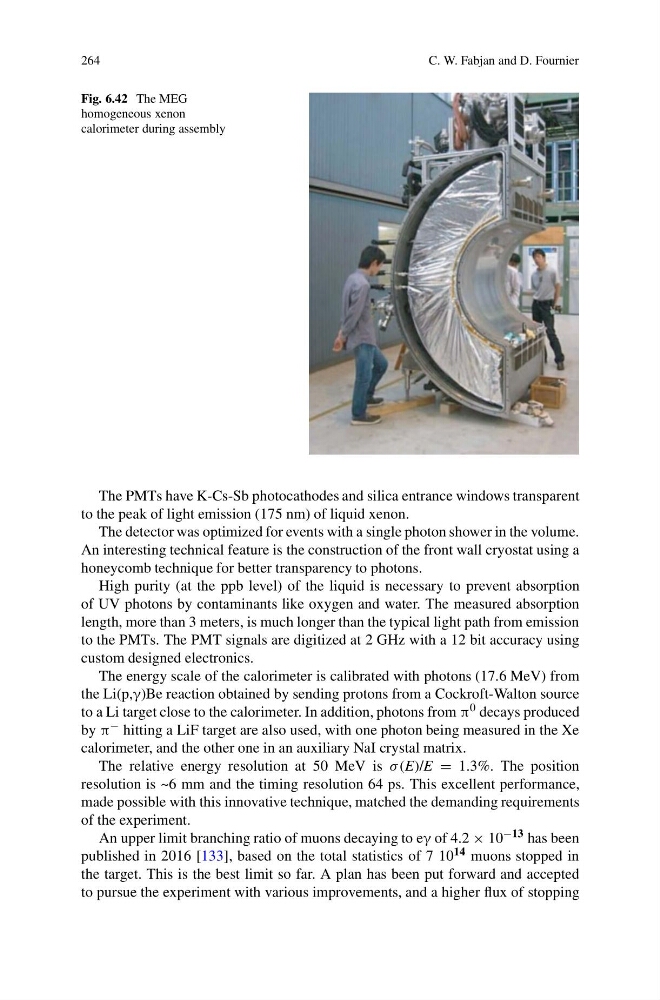
Fig. 6.42 The MEG
homogeneous xenon
calorimeter during assembly
The PMTs have K-Cs-Sb photocathodes and silica entrance windows transparent
to the peak of light emission (175 nm) of liquid xenon.
The detector was optimized for events with a single photon shower in the volume.
An interesting technical feature is the construction of the front wall cryostat using a
honeycomb technique for better transparency to photons.
High purity (at the ppb level) of the liquid is necessary to prevent absorption
of UV photons by contaminants like oxygen and water. The measured absorption
length, more than 3 meters, is much longer than the typical light path from emission
to the PMTs. The PMT signals are digitized at 2 GHz with a 12 bit accuracy using
custom designed electronics.
The energy scale of the calorimeter is calibrated with photons (17.6 MeV) from
the Li(p,γ)Be reaction obtained by sending protons from a Cockroft-Walton source
to a Li target close to the calorimeter. In addition, photons from π 0 decays produced
by π − hitting a LiF target are also used, with one photon being measured in the Xe
calorimeter, and the other one in an auxiliary NaI crystal matrix.
The relative energy resolution at 50 MeV is σ (E)/E = 1.3%. The position
resolution is ~6 mm and the timing resolution 64 ps. This excellent performance,
made possible with this innovative technique, matched the demanding requirements
of the experiment.
An upper limit branching ratio of muons decaying to eγ of 4.2 × 10 −13 has been
published in 2016 [133], based on the total statistics of 7 10 14 muons stopped in
the target. This is the best limit so far. A plan has been put forward and accepted
to pursue the experiment with various improvements, and a higher flux of stopping
C. W. Fabjan and D. Fournier
Fig. 6.42 The MEG
homogeneous xenon
calorimeter during assembly
The PMTs have K-Cs-Sb photocathodes and silica entrance windows transparent
to the peak of light emission (175 nm) of liquid xenon.
The detector was optimized for events with a single photon shower in the volume.
An interesting technical feature is the construction of the front wall cryostat using a
honeycomb technique for better transparency to photons.
High purity (at the ppb level) of the liquid is necessary to prevent absorption
of UV photons by contaminants like oxygen and water. The measured absorption
length, more than 3 meters, is much longer than the typical light path from emission
to the PMTs. The PMT signals are digitized at 2 GHz with a 12 bit accuracy using
custom designed electronics.
The energy scale of the calorimeter is calibrated with photons (17.6 MeV) from
the Li(p,γ)Be reaction obtained by sending protons from a Cockroft-Walton source
to a Li target close to the calorimeter. In addition, photons from π 0 decays produced
by π − hitting a LiF target are also used, with one photon being measured in the Xe
calorimeter, and the other one in an auxiliary NaI crystal matrix.
The relative energy resolution at 50 MeV is σ (E)/E = 1.3%. The position
resolution is ~6 mm and the timing resolution 64 ps. This excellent performance,
made possible with this innovative technique, matched the demanding requirements
of the experiment.
An upper limit branching ratio of muons decaying to eγ of 4.2 × 10 −13 has been
published in 2016 [133], based on the total statistics of 7 10 14 muons stopped in
the target. This is the best limit so far. A plan has been put forward and accepted
to pursue the experiment with various improvements, and a higher flux of stopping