

6 Calorimetry
255
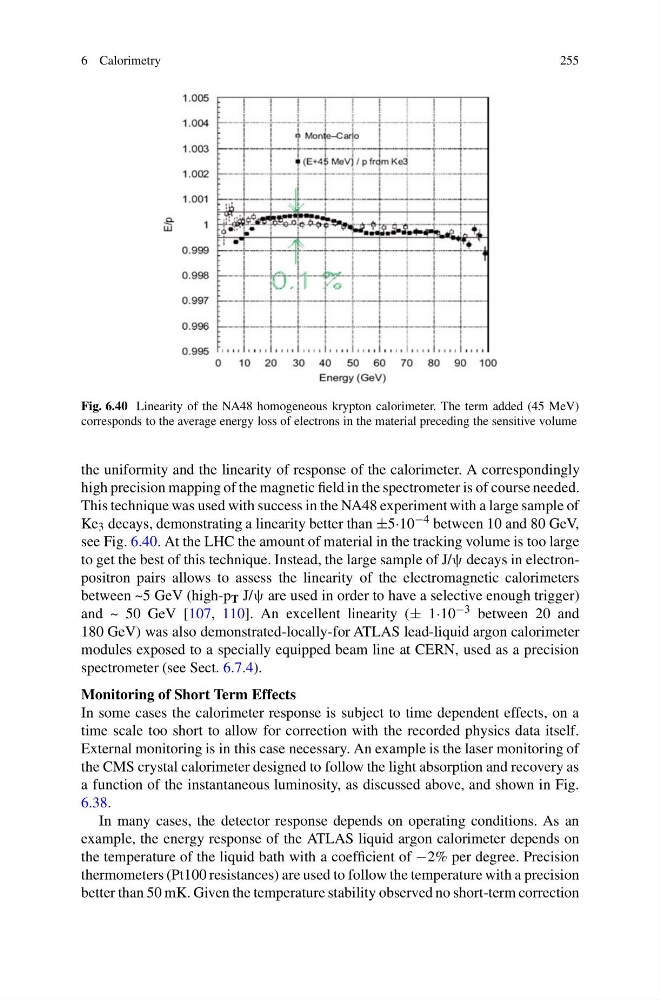
Fig. 6.40 Linearity of the NA48 homogeneous krypton calorimeter. The term added (45 MeV)
corresponds to the average energy loss of electrons in the material preceding the sensitive volume
the uniformity and the linearity of response of the calorimeter. A correspondingly
high precision mapping of the magnetic field in the spectrometer is of course needed.
This technique was used with success in the NA48 experiment with a large sample of
Ke 3 decays, demonstrating a linearity better than ±5·10 −4 between 10 and 80 GeV,
see Fig. 6.40. At the LHC the amount of material in the tracking volume is too large
to get the best of this technique. Instead, the large sample of J/ψ decays in electronpositron pairs allows to assess the linearity of the electromagnetic calorimeters
between ~5 GeV (high-p T J/ψ are used in order to have a selective enough trigger)
and ~ 50 GeV [107, 110]. An excellent linearity (± 1·10 −3 between 20 and
180 GeV) was also demonstrated-locally-for ATLAS lead-liquid argon calorimeter
modules exposed to a specially equipped beam line at CERN, used as a precision
spectrometer (see Sect. 6.7.4).
Monitoring of Short Term Effects
In some cases the calorimeter response is subject to time dependent effects, on a
time scale too short to allow for correction with the recorded physics data itself.
External monitoring is in this case necessary. An example is the laser monitoring of
the CMS crystal calorimeter designed to follow the light absorption and recovery as
a function of the instantaneous luminosity, as discussed above, and shown in Fig.
6.38.
In many cases, the detector response depends on operating conditions. As an
example, the energy response of the ATLAS liquid argon calorimeter depends on
the temperature of the liquid bath with a coefficient of −2% per degree. Precision
thermometers (Pt100 resistances) are used to follow the temperature with a precision
better than 50 mK. Given the temperature stability observed no short-term correction
255
Fig. 6.40 Linearity of the NA48 homogeneous krypton calorimeter. The term added (45 MeV)
corresponds to the average energy loss of electrons in the material preceding the sensitive volume
the uniformity and the linearity of response of the calorimeter. A correspondingly
high precision mapping of the magnetic field in the spectrometer is of course needed.
This technique was used with success in the NA48 experiment with a large sample of
Ke 3 decays, demonstrating a linearity better than ±5·10 −4 between 10 and 80 GeV,
see Fig. 6.40. At the LHC the amount of material in the tracking volume is too large
to get the best of this technique. Instead, the large sample of J/ψ decays in electronpositron pairs allows to assess the linearity of the electromagnetic calorimeters
between ~5 GeV (high-p T J/ψ are used in order to have a selective enough trigger)
and ~ 50 GeV [107, 110]. An excellent linearity (± 1·10 −3 between 20 and
180 GeV) was also demonstrated-locally-for ATLAS lead-liquid argon calorimeter
modules exposed to a specially equipped beam line at CERN, used as a precision
spectrometer (see Sect. 6.7.4).
Monitoring of Short Term Effects
In some cases the calorimeter response is subject to time dependent effects, on a
time scale too short to allow for correction with the recorded physics data itself.
External monitoring is in this case necessary. An example is the laser monitoring of
the CMS crystal calorimeter designed to follow the light absorption and recovery as
a function of the instantaneous luminosity, as discussed above, and shown in Fig.
6.38.
In many cases, the detector response depends on operating conditions. As an
example, the energy response of the ATLAS liquid argon calorimeter depends on
the temperature of the liquid bath with a coefficient of −2% per degree. Precision
thermometers (Pt100 resistances) are used to follow the temperature with a precision
better than 50 mK. Given the temperature stability observed no short-term correction