

254
C. W. Fabjan and D. Fournier
12000
10000
8000
6000
4000
2000
0
0.05
0.1
0.15
0.2
0.25
m γγ [GeV]
Entries/0.001GeV
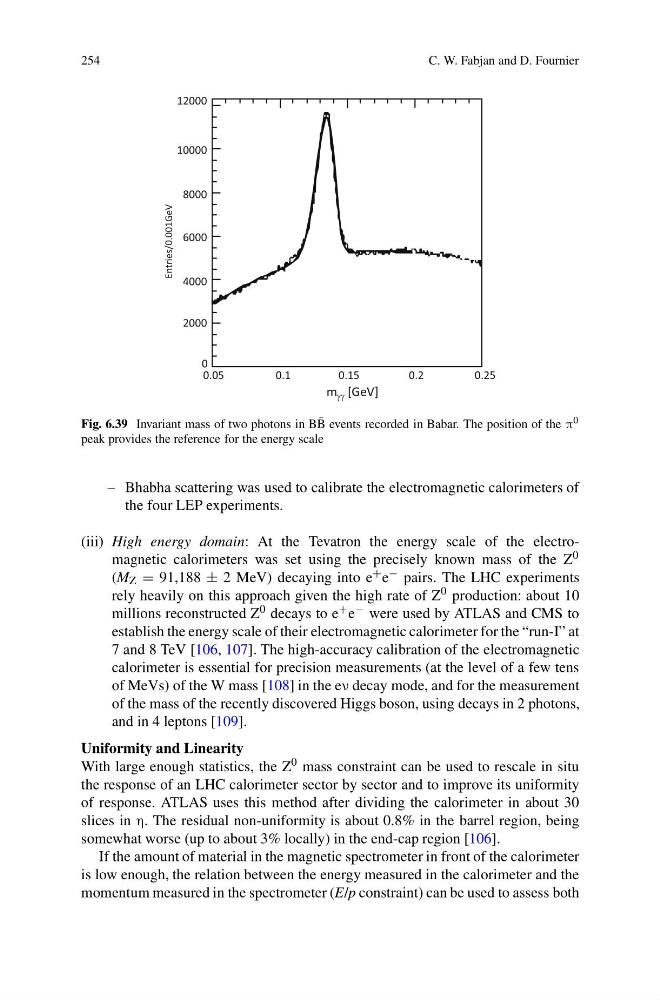
Fig. 6.39 Invariant mass of two photons in B ¯
B events recorded in Babar. The position of the π 0
peak provides the reference for the energy scale
– Bhabha scattering was used to calibrate the electromagnetic calorimeters of
the four LEP experiments.
(iii) High energy domain: At the Tevatron the energy scale of the electromagnetic calorimeters was set using the precisely known mass of the Z 0
(M Z = 91,188 ± 2 MeV) decaying into e + e − pairs. The LHC experiments
rely heavily on this approach given the high rate of Z 0 production: about 10
millions reconstructed Z 0 decays to e + e − were used by ATLAS and CMS to
establish the energy scale of their electromagnetic calorimeter for the “run-I” at
7 and 8 TeV [106, 107]. The high-accuracy calibration of the electromagnetic
calorimeter is essential for precision measurements (at the level of a few tens
of MeVs) of the W mass [108] in the eν decay mode, and for the measurement
of the mass of the recently discovered Higgs boson, using decays in 2 photons,
and in 4 leptons [109].
Uniformity and Linearity
With large enough statistics, the Z 0 mass constraint can be used to rescale in situ
the response of an LHC calorimeter sector by sector and to improve its uniformity
of response. ATLAS uses this method after dividing the calorimeter in about 30
slices in η. The residual non-uniformity is about 0.8% in the barrel region, being
somewhat worse (up to about 3% locally) in the end-cap region [106].
If the amount of material in the magnetic spectrometer in front of the calorimeter
is low enough, the relation between the energy measured in the calorimeter and the
momentum measured in the spectrometer (E/p constraint) can be used to assess both
C. W. Fabjan and D. Fournier
12000
10000
8000
6000
4000
2000
0
0.05
0.1
0.15
0.2
0.25
m γγ [GeV]
Entries/0.001GeV
Fig. 6.39 Invariant mass of two photons in B ¯
B events recorded in Babar. The position of the π 0
peak provides the reference for the energy scale
– Bhabha scattering was used to calibrate the electromagnetic calorimeters of
the four LEP experiments.
(iii) High energy domain: At the Tevatron the energy scale of the electromagnetic calorimeters was set using the precisely known mass of the Z 0
(M Z = 91,188 ± 2 MeV) decaying into e + e − pairs. The LHC experiments
rely heavily on this approach given the high rate of Z 0 production: about 10
millions reconstructed Z 0 decays to e + e − were used by ATLAS and CMS to
establish the energy scale of their electromagnetic calorimeter for the “run-I” at
7 and 8 TeV [106, 107]. The high-accuracy calibration of the electromagnetic
calorimeter is essential for precision measurements (at the level of a few tens
of MeVs) of the W mass [108] in the eν decay mode, and for the measurement
of the mass of the recently discovered Higgs boson, using decays in 2 photons,
and in 4 leptons [109].
Uniformity and Linearity
With large enough statistics, the Z 0 mass constraint can be used to rescale in situ
the response of an LHC calorimeter sector by sector and to improve its uniformity
of response. ATLAS uses this method after dividing the calorimeter in about 30
slices in η. The residual non-uniformity is about 0.8% in the barrel region, being
somewhat worse (up to about 3% locally) in the end-cap region [106].
If the amount of material in the magnetic spectrometer in front of the calorimeter
is low enough, the relation between the energy measured in the calorimeter and the
momentum measured in the spectrometer (E/p constraint) can be used to assess both