

2 The Interaction of Radiation with Matter
15
The perturbation due to the moving charge is assumed to be weak enough such
that there is a linear relationship between the Fourier components of the electric
field E and the displacement field D,
D (k, ω) = ε (k, ω) E (k, ω) ,
where ε (k, ω) = ε 1 (k, ω) + iε 2 (k, ω) is the (generalized) complex dielectric
function.
The particle experiences a force zeE (r = βct, t) that slows it down, and the
stopping power is given by the component of this force parallel to the particle’s
direction of motion,
dE
dx
= zeE ·
β
β
.
Adopting the Coulomb gauge k·A = 0, one obtains after integrating over the angles
(assuming that the dielectric function ε is isotropic),
dE
dx
= −
2z 2 e 2
β 2 π
dω
dk
×
ω
kc 2 Im
−1
ε (k, ω)
+ ωk
β
2
−
ω 2
k 2 c 2
Im
1
−k 2 c 2 + ε (k, ω) ω 2
.
(2.16)
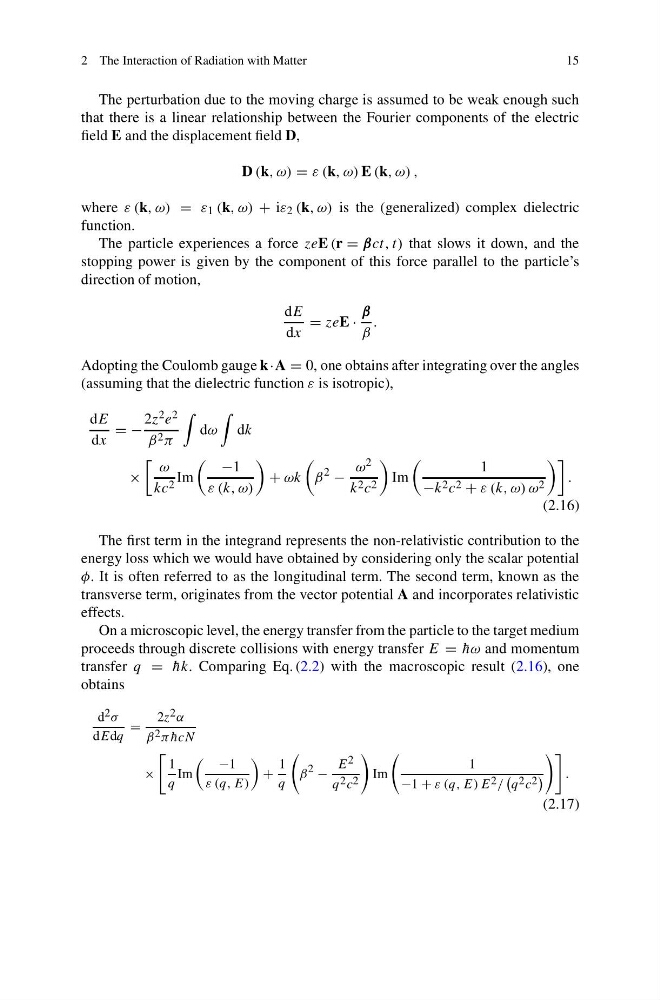
The first term in the integrand represents the non-relativistic contribution to the
energy loss which we would have obtained by considering only the scalar potential
φ. It is often referred to as the longitudinal term. The second term, known as the
transverse term, originates from the vector potential A and incorporates relativistic
effects.
On a microscopic level, the energy transfer from the particle to the target medium
proceeds through discrete collisions with energy transfer E = ¯
hω and momentum
transfer q = ¯
hk. Comparing Eq. (2.2) with the macroscopic result (2.16), one
obtains
d 2 σ
dEdq
=
2z 2 α
β 2 π ¯
hcN
×
1
q
Im
−1
ε (q, E)
+
1
q
β 2 −
E 2
q 2 c 2
Im
1
−1 + ε (q, E) E 2 /
q 2 c 2
.
(2.17)
15
The perturbation due to the moving charge is assumed to be weak enough such
that there is a linear relationship between the Fourier components of the electric
field E and the displacement field D,
D (k, ω) = ε (k, ω) E (k, ω) ,
where ε (k, ω) = ε 1 (k, ω) + iε 2 (k, ω) is the (generalized) complex dielectric
function.
The particle experiences a force zeE (r = βct, t) that slows it down, and the
stopping power is given by the component of this force parallel to the particle’s
direction of motion,
dE
dx
= zeE ·
β
β
.
Adopting the Coulomb gauge k·A = 0, one obtains after integrating over the angles
(assuming that the dielectric function ε is isotropic),
dE
dx
= −
2z 2 e 2
β 2 π
dω
dk
×
ω
kc 2 Im
−1
ε (k, ω)
+ ωk
β
2
−
ω 2
k 2 c 2
Im
1
−k 2 c 2 + ε (k, ω) ω 2
.
(2.16)
The first term in the integrand represents the non-relativistic contribution to the
energy loss which we would have obtained by considering only the scalar potential
φ. It is often referred to as the longitudinal term. The second term, known as the
transverse term, originates from the vector potential A and incorporates relativistic
effects.
On a microscopic level, the energy transfer from the particle to the target medium
proceeds through discrete collisions with energy transfer E = ¯
hω and momentum
transfer q = ¯
hk. Comparing Eq. (2.2) with the macroscopic result (2.16), one
obtains
d 2 σ
dEdq
=
2z 2 α
β 2 π ¯
hcN
×
1
q
Im
−1
ε (q, E)
+
1
q
β 2 −
E 2
q 2 c 2
Im
1
−1 + ε (q, E) E 2 /
q 2 c 2
.
(2.17)