

14
H. Bichsel and H. Schindler
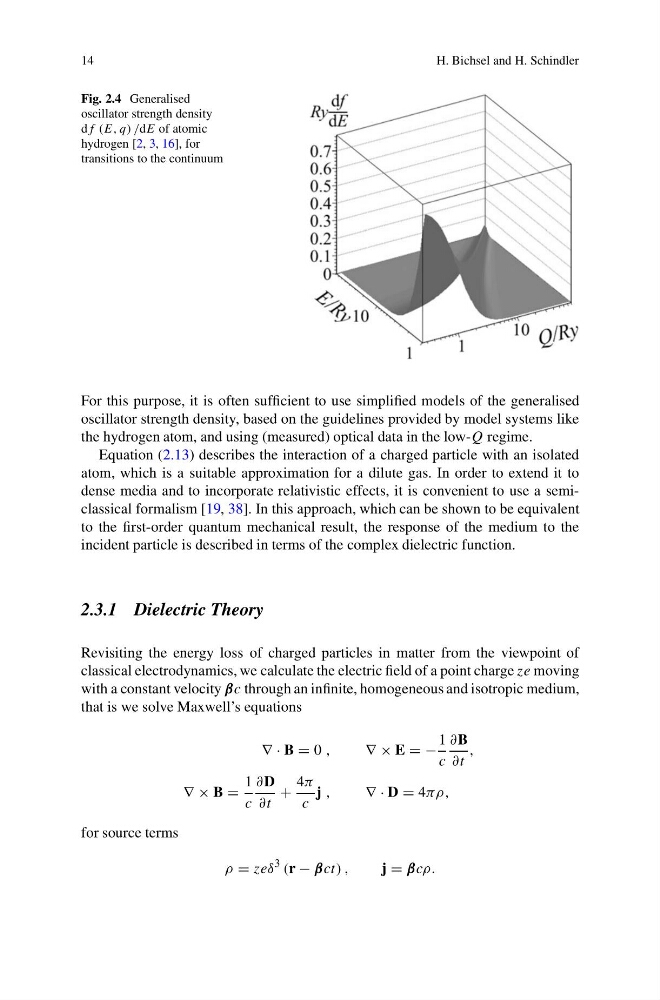
Fig. 2.4 Generalised
oscillator strength density
df (E, q) /dE of atomic
hydrogen [2, 3, 16], for
transitions to the continuum
For this purpose, it is often sufficient to use simplified models of the generalised
oscillator strength density, based on the guidelines provided by model systems like
the hydrogen atom, and using (measured) optical data in the low-Q regime.
Equation (2.13) describes the interaction of a charged particle with an isolated
atom, which is a suitable approximation for a dilute gas. In order to extend it to
dense media and to incorporate relativistic effects, it is convenient to use a semiclassical formalism [19, 38]. In this approach, which can be shown to be equivalent
to the first-order quantum mechanical result, the response of the medium to the
incident particle is described in terms of the complex dielectric function.
2.3.1 Dielectric Theory
Revisiting the energy loss of charged particles in matter from the viewpoint of
classical electrodynamics, we calculate the electric field of a point charge ze moving
with a constant velocity βc through an infinite, homogeneous and isotropic medium,
that is we solve Maxwell’s equations
∇ · B = 0 ,
∇ × E = −
1
c
∂B
∂t
,
∇ × B =
1
c
∂D
∂t
+
4π
c
j ,
∇ · D = 4πρ,
for source terms
ρ = zeδ
3 (r − βct) ,
j = βcρ.
H. Bichsel and H. Schindler
Fig. 2.4 Generalised
oscillator strength density
df (E, q) /dE of atomic
hydrogen [2, 3, 16], for
transitions to the continuum
For this purpose, it is often sufficient to use simplified models of the generalised
oscillator strength density, based on the guidelines provided by model systems like
the hydrogen atom, and using (measured) optical data in the low-Q regime.
Equation (2.13) describes the interaction of a charged particle with an isolated
atom, which is a suitable approximation for a dilute gas. In order to extend it to
dense media and to incorporate relativistic effects, it is convenient to use a semiclassical formalism [19, 38]. In this approach, which can be shown to be equivalent
to the first-order quantum mechanical result, the response of the medium to the
incident particle is described in terms of the complex dielectric function.
2.3.1 Dielectric Theory
Revisiting the energy loss of charged particles in matter from the viewpoint of
classical electrodynamics, we calculate the electric field of a point charge ze moving
with a constant velocity βc through an infinite, homogeneous and isotropic medium,
that is we solve Maxwell’s equations
∇ · B = 0 ,
∇ × E = −
1
c
∂B
∂t
,
∇ × B =
1
c
∂D
∂t
+
4π
c
j ,
∇ · D = 4πρ,
for source terms
ρ = zeδ
3 (r − βct) ,
j = βcρ.