

224
C. W. Fabjan and D. Fournier
multiplicity m of a collision, with k = ln (1 − f π0 )/ln m. The parameter E 0
denotes the average energy necessary for the production of a pion, approximately
E 0 ≈ 2 GeV; with the multiplicity m ≈ 6–7 of hadrons produced in a hadronic
collision k is ≈ −0.2. Values of F h are of order 0.5 (0.3) for 100 (1000) GeV
showers. As the energy of the incident hadron increases, it is doomed to dissipate its
energy in a flash of photons. Were one to extrapolate this power law to the highest
particles energies detected calorimetrically, E ≤ 10 20 eV more than 98% of the
hadronic energy would be converted to electromagnetic energy!
The low-energy nuclear part of the hadronic cascade has very different properties,
but carries the dominant part of the energy in the hadronic sector. In the energetic
hadron collisions with the nuclei of the calorimeter material, their nucleons will be
struck initiating an ‘intra-nuclear’ cascade. In the subsequent steps, the intermediate
nucleus will de-excite, in general through a spallation reaction, evaporating a
considerable number of nucleons, accompanied by few MeV γ-emission. The
binding energy of these nucleons released in these collisions is taken from the
energy of the incident hadron. The number of these low-energy neutrons is large:
~ 20 neutron/GeV in lead. The fraction of the total associated binding energy
depends on the incident energy and may be as high as ~20–40%. These neutrons
will ultimately be captured by the target nuclei, resulting in delayed nuclear photon
emission (at the ~ μs timescale). The energy lost to binding energy is therefore, in
general, not detected (‘invisible’) in practical calorimeters.
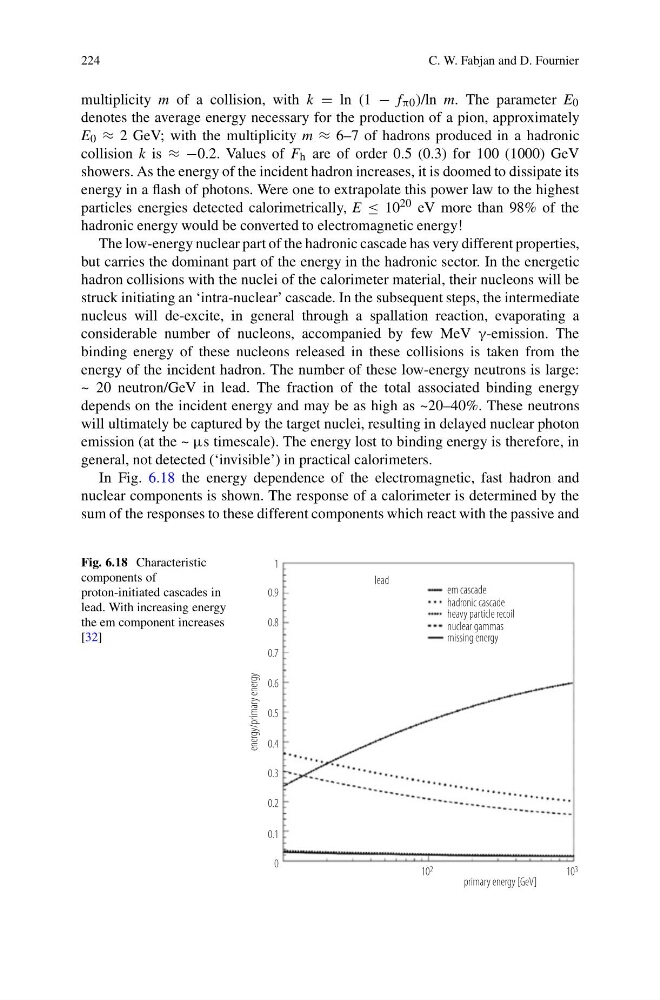
In Fig. 6.18 the energy dependence of the electromagnetic, fast hadron and
nuclear components is shown. The response of a calorimeter is determined by the
sum of the responses to these different components which react with the passive and
Fig. 6.18 Characteristic
components of
proton-initiated cascades in
lead. With increasing energy
the em component increases
[32]
1
0.9
lead
em cascade
hadronic cascade
heavy particle recoil
nuclear gammas
missing energy
energy/primary energy
0.8
0.7
0.6
0.5
0.4
0.3
0.2
0.1
0
10 2
10 3
primary energy [GeV]
C. W. Fabjan and D. Fournier
multiplicity m of a collision, with k = ln (1 − f π0 )/ln m. The parameter E 0
denotes the average energy necessary for the production of a pion, approximately
E 0 ≈ 2 GeV; with the multiplicity m ≈ 6–7 of hadrons produced in a hadronic
collision k is ≈ −0.2. Values of F h are of order 0.5 (0.3) for 100 (1000) GeV
showers. As the energy of the incident hadron increases, it is doomed to dissipate its
energy in a flash of photons. Were one to extrapolate this power law to the highest
particles energies detected calorimetrically, E ≤ 10 20 eV more than 98% of the
hadronic energy would be converted to electromagnetic energy!
The low-energy nuclear part of the hadronic cascade has very different properties,
but carries the dominant part of the energy in the hadronic sector. In the energetic
hadron collisions with the nuclei of the calorimeter material, their nucleons will be
struck initiating an ‘intra-nuclear’ cascade. In the subsequent steps, the intermediate
nucleus will de-excite, in general through a spallation reaction, evaporating a
considerable number of nucleons, accompanied by few MeV γ-emission. The
binding energy of these nucleons released in these collisions is taken from the
energy of the incident hadron. The number of these low-energy neutrons is large:
~ 20 neutron/GeV in lead. The fraction of the total associated binding energy
depends on the incident energy and may be as high as ~20–40%. These neutrons
will ultimately be captured by the target nuclei, resulting in delayed nuclear photon
emission (at the ~ μs timescale). The energy lost to binding energy is therefore, in
general, not detected (‘invisible’) in practical calorimeters.
In Fig. 6.18 the energy dependence of the electromagnetic, fast hadron and
nuclear components is shown. The response of a calorimeter is determined by the
sum of the responses to these different components which react with the passive and
Fig. 6.18 Characteristic
components of
proton-initiated cascades in
lead. With increasing energy
the em component increases
[32]
1
0.9
lead
em cascade
hadronic cascade
heavy particle recoil
nuclear gammas
missing energy
energy/primary energy
0.8
0.7
0.6
0.5
0.4
0.3
0.2
0.1
0
10 2
10 3
primary energy [GeV]