

6 Calorimetry
223
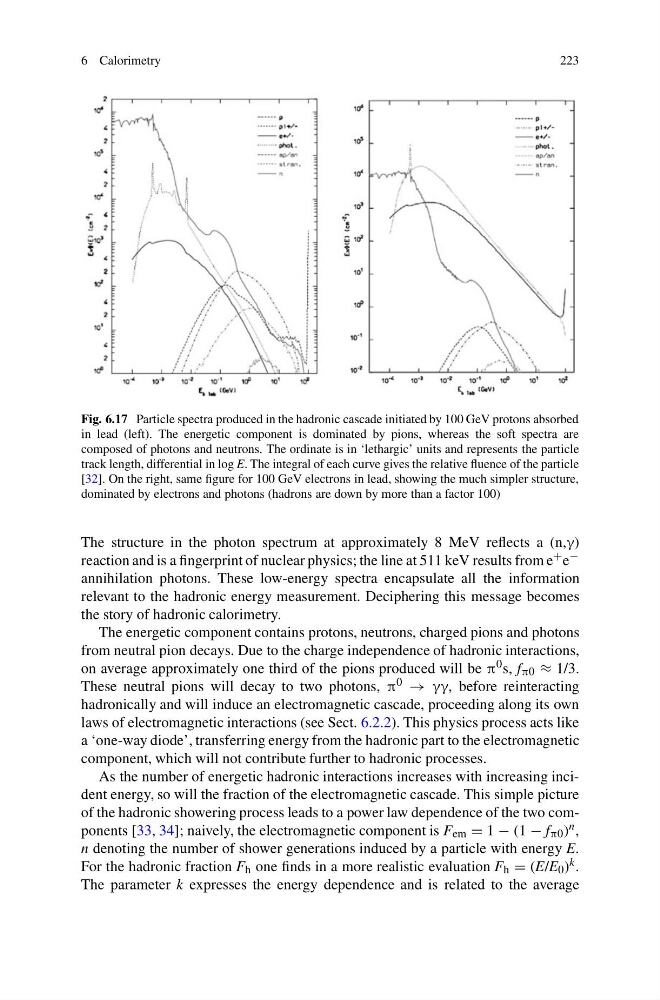
Fig. 6.17 Particle spectra produced in the hadronic cascade initiated by 100 GeV protons absorbed
in lead (left). The energetic component is dominated by pions, whereas the soft spectra are
composed of photons and neutrons. The ordinate is in ‘lethargic’ units and represents the particle
track length, differential in log E. The integral of each curve gives the relative fluence of the particle
[32]. On the right, same figure for 100 GeV electrons in lead, showing the much simpler structure,
dominated by electrons and photons (hadrons are down by more than a factor 100)
The structure in the photon spectrum at approximately 8 MeV reflects a (n,γ)
reaction and is a fingerprint of nuclear physics; the line at 511 keV results from e + e −
annihilation photons. These low-energy spectra encapsulate all the information
relevant to the hadronic energy measurement. Deciphering this message becomes
the story of hadronic calorimetry.
The energetic component contains protons, neutrons, charged pions and photons
from neutral pion decays. Due to the charge independence of hadronic interactions,
on average approximately one third of the pions produced will be π 0 s, f π0 ≈ 1/3.
These neutral pions will decay to two photons, π 0 → γγ, before reinteracting
hadronically and will induce an electromagnetic cascade, proceeding along its own
laws of electromagnetic interactions (see Sect. 6.2.2). This physics process acts like
a ‘one-way diode’, transferring energy from the hadronic part to the electromagnetic
component, which will not contribute further to hadronic processes.
As the number of energetic hadronic interactions increases with increasing incident energy, so will the fraction of the electromagnetic cascade. This simple picture
of the hadronic showering process leads to a power law dependence of the two components [33, 34]; naively, the electromagnetic component is F em = 1 − (1 − f π0 ) n ,
n denoting the number of shower generations induced by a particle with energy E.
For the hadronic fraction F h one finds in a more realistic evaluation F h = (E/E 0 ) k .
The parameter k expresses the energy dependence and is related to the average
223
Fig. 6.17 Particle spectra produced in the hadronic cascade initiated by 100 GeV protons absorbed
in lead (left). The energetic component is dominated by pions, whereas the soft spectra are
composed of photons and neutrons. The ordinate is in ‘lethargic’ units and represents the particle
track length, differential in log E. The integral of each curve gives the relative fluence of the particle
[32]. On the right, same figure for 100 GeV electrons in lead, showing the much simpler structure,
dominated by electrons and photons (hadrons are down by more than a factor 100)
The structure in the photon spectrum at approximately 8 MeV reflects a (n,γ)
reaction and is a fingerprint of nuclear physics; the line at 511 keV results from e + e −
annihilation photons. These low-energy spectra encapsulate all the information
relevant to the hadronic energy measurement. Deciphering this message becomes
the story of hadronic calorimetry.
The energetic component contains protons, neutrons, charged pions and photons
from neutral pion decays. Due to the charge independence of hadronic interactions,
on average approximately one third of the pions produced will be π 0 s, f π0 ≈ 1/3.
These neutral pions will decay to two photons, π 0 → γγ, before reinteracting
hadronically and will induce an electromagnetic cascade, proceeding along its own
laws of electromagnetic interactions (see Sect. 6.2.2). This physics process acts like
a ‘one-way diode’, transferring energy from the hadronic part to the electromagnetic
component, which will not contribute further to hadronic processes.
As the number of energetic hadronic interactions increases with increasing incident energy, so will the fraction of the electromagnetic cascade. This simple picture
of the hadronic showering process leads to a power law dependence of the two components [33, 34]; naively, the electromagnetic component is F em = 1 − (1 − f π0 ) n ,
n denoting the number of shower generations induced by a particle with energy E.
For the hadronic fraction F h one finds in a more realistic evaluation F h = (E/E 0 ) k .
The parameter k expresses the energy dependence and is related to the average