

5 Solid State Detectors
185
DEPFET Pixel Detector Applications
In the last years DEPFET pixel detectors have been developed at the MPI Semiconductor Laboratory for the following projects:
Bepi Colombo, a mission for observing mercury [42], XEUS/IXO a space based
X-ray observatory that will succeed the XMM/Newton and vertex detectors for
the International Linear Collider (ILC) and the BELLE-II experiment at the KEK
e + e – collider.
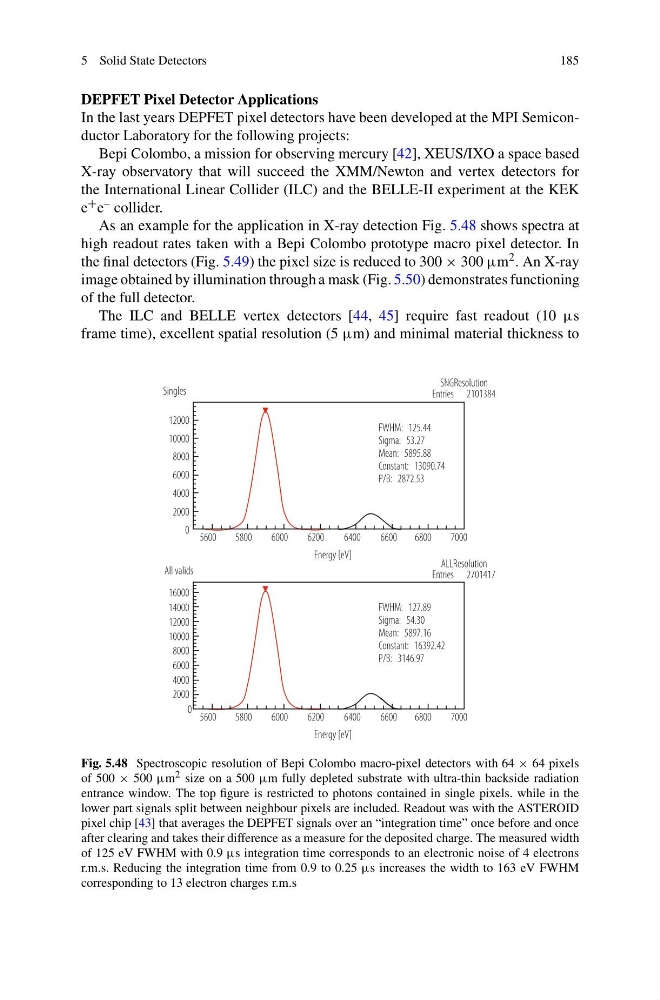
As an example for the application in X-ray detection Fig. 5.48 shows spectra at
high readout rates taken with a Bepi Colombo prototype macro pixel detector. In
the final detectors (Fig. 5.49) the pixel size is reduced to 300 × 300 μm 2 . An X-ray
image obtained by illumination through a mask (Fig. 5.50) demonstrates functioning
of the full detector.
The ILC and BELLE vertex detectors [44, 45] require fast readout (10 μs
frame time), excellent spatial resolution (5 μm) and minimal material thickness to
Fig. 5.48 Spectroscopic resolution of Bepi Colombo macro-pixel detectors with 64 × 64 pixels
of 500 × 500 μm 2 size on a 500 μm fully depleted substrate with ultra-thin backside radiation
entrance window. The top figure is restricted to photons contained in single pixels. while in the
lower part signals split between neighbour pixels are included. Readout was with the ASTEROID
pixel chip [43] that averages the DEPFET signals over an “integration time” once before and once
after clearing and takes their difference as a measure for the deposited charge. The measured width
of 125 eV FWHM with 0.9 μs integration time corresponds to an electronic noise of 4 electrons
r.m.s. Reducing the integration time from 0.9 to 0.25 μs increases the width to 163 eV FWHM
corresponding to 13 electron charges r.m.s
185
DEPFET Pixel Detector Applications
In the last years DEPFET pixel detectors have been developed at the MPI Semiconductor Laboratory for the following projects:
Bepi Colombo, a mission for observing mercury [42], XEUS/IXO a space based
X-ray observatory that will succeed the XMM/Newton and vertex detectors for
the International Linear Collider (ILC) and the BELLE-II experiment at the KEK
e + e – collider.
As an example for the application in X-ray detection Fig. 5.48 shows spectra at
high readout rates taken with a Bepi Colombo prototype macro pixel detector. In
the final detectors (Fig. 5.49) the pixel size is reduced to 300 × 300 μm 2 . An X-ray
image obtained by illumination through a mask (Fig. 5.50) demonstrates functioning
of the full detector.
The ILC and BELLE vertex detectors [44, 45] require fast readout (10 μs
frame time), excellent spatial resolution (5 μm) and minimal material thickness to
Fig. 5.48 Spectroscopic resolution of Bepi Colombo macro-pixel detectors with 64 × 64 pixels
of 500 × 500 μm 2 size on a 500 μm fully depleted substrate with ultra-thin backside radiation
entrance window. The top figure is restricted to photons contained in single pixels. while in the
lower part signals split between neighbour pixels are included. Readout was with the ASTEROID
pixel chip [43] that averages the DEPFET signals over an “integration time” once before and once
after clearing and takes their difference as a measure for the deposited charge. The measured width
of 125 eV FWHM with 0.9 μs integration time corresponds to an electronic noise of 4 electrons
r.m.s. Reducing the integration time from 0.9 to 0.25 μs increases the width to 163 eV FWHM
corresponding to 13 electron charges r.m.s