

154
G. Lutz and R. Klanner
5.7 Detector Front-End Electronics
Before discussing more sophisticated detectors we now turn to readout electronics,
a subject relevant to all detectors. As there is a close interplay between a detector
and its electronics, both components have to be considered together when designing
a detector for a specific application. In most cases a signal charge produced by
photons or ionizing radiation has to be measured as precisely as possible in a
predefined time interval and with tolerable power consumption. Readout uses in
most cases large scale integrated (LSI) electronics adapted to the needs of the special
application.
5.7.1 Operating Principles of Transistors
Transistors are commonly classified into unipolar and bipolar, depending on
whether only one or both types of charge carriers participate in the current flow.
As a consequence of the difference in operating principles, their properties—and
therefore their suitability for specific applications—differ greatly. Bipolar transistors
are well suited for high-speed applications and for driving large currents. Unipolar
transistors are common in moderate-speed low-noise applications (JFETs) and are
most prominent in digital circuitry (MOSFETs).
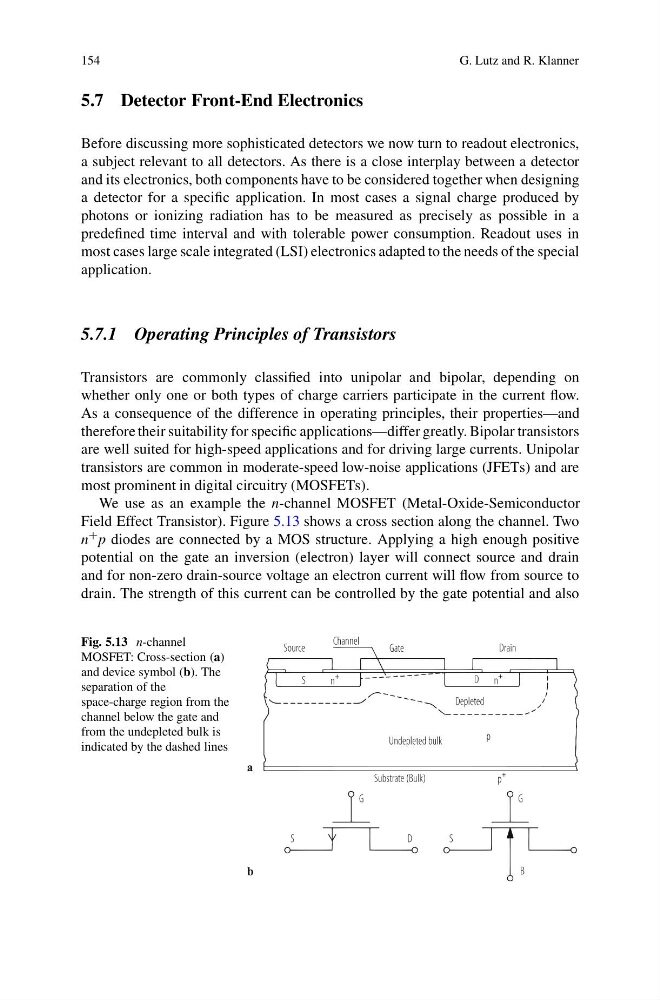
We use as an example the n-channel MOSFET (Metal-Oxide-Semiconductor
Field Effect Transistor). Figure 5.13 shows a cross section along the channel. Two
n + p diodes are connected by a MOS structure. Applying a high enough positive
potential on the gate an inversion (electron) layer will connect source and drain
and for non-zero drain-source voltage an electron current will flow from source to
drain. The strength of this current can be controlled by the gate potential and also
Fig. 5.13 n-channel
MOSFET: Cross-section (a)
and device symbol (b). The
separation of the
space-charge region from the
channel below the gate and
from the undepleted bulk is
indicated by the dashed lines
G. Lutz and R. Klanner
5.7 Detector Front-End Electronics
Before discussing more sophisticated detectors we now turn to readout electronics,
a subject relevant to all detectors. As there is a close interplay between a detector
and its electronics, both components have to be considered together when designing
a detector for a specific application. In most cases a signal charge produced by
photons or ionizing radiation has to be measured as precisely as possible in a
predefined time interval and with tolerable power consumption. Readout uses in
most cases large scale integrated (LSI) electronics adapted to the needs of the special
application.
5.7.1 Operating Principles of Transistors
Transistors are commonly classified into unipolar and bipolar, depending on
whether only one or both types of charge carriers participate in the current flow.
As a consequence of the difference in operating principles, their properties—and
therefore their suitability for specific applications—differ greatly. Bipolar transistors
are well suited for high-speed applications and for driving large currents. Unipolar
transistors are common in moderate-speed low-noise applications (JFETs) and are
most prominent in digital circuitry (MOSFETs).
We use as an example the n-channel MOSFET (Metal-Oxide-Semiconductor
Field Effect Transistor). Figure 5.13 shows a cross section along the channel. Two
n + p diodes are connected by a MOS structure. Applying a high enough positive
potential on the gate an inversion (electron) layer will connect source and drain
and for non-zero drain-source voltage an electron current will flow from source to
drain. The strength of this current can be controlled by the gate potential and also
Fig. 5.13 n-channel
MOSFET: Cross-section (a)
and device symbol (b). The
separation of the
space-charge region from the
channel below the gate and
from the undepleted bulk is
indicated by the dashed lines