

150
G. Lutz and R. Klanner
such that they would collect no signal charge, and thus charge division would cease
to function.
5.6.2 Strip Detectors with Double-Sided Readout
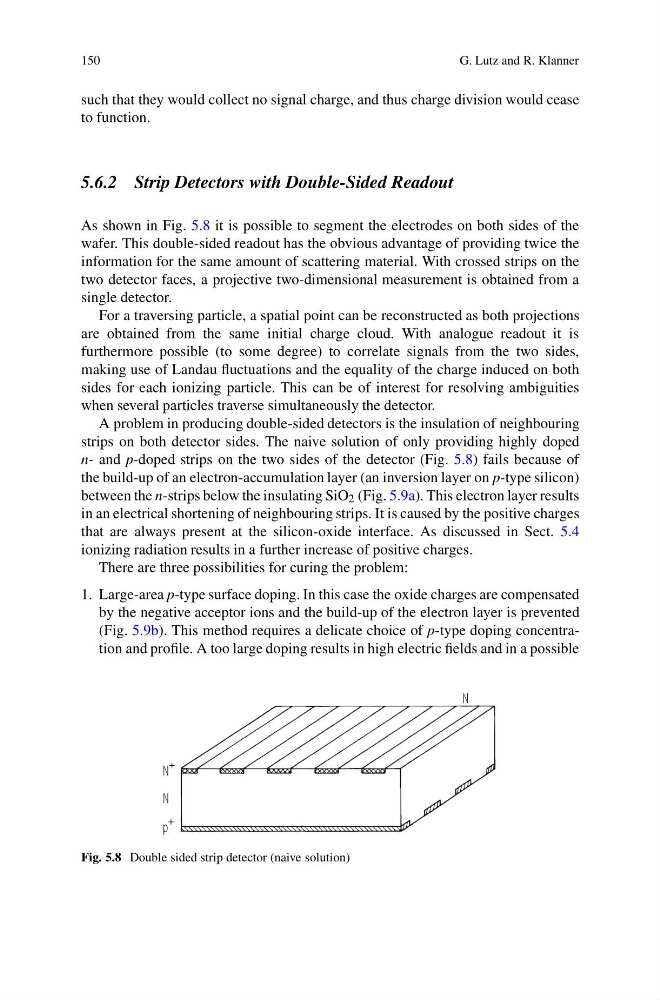
As shown in Fig. 5.8 it is possible to segment the electrodes on both sides of the
wafer. This double-sided readout has the obvious advantage of providing twice the
information for the same amount of scattering material. With crossed strips on the
two detector faces, a projective two-dimensional measurement is obtained from a
single detector.
For a traversing particle, a spatial point can be reconstructed as both projections
are obtained from the same initial charge cloud. With analogue readout it is
furthermore possible (to some degree) to correlate signals from the two sides,
making use of Landau fluctuations and the equality of the charge induced on both
sides for each ionizing particle. This can be of interest for resolving ambiguities
when several particles traverse simultaneously the detector.
A problem in producing double-sided detectors is the insulation of neighbouring
strips on both detector sides. The naive solution of only providing highly doped
n- and p-doped strips on the two sides of the detector (Fig. 5.8) fails because of
the build-up of an electron-accumulation layer (an inversion layer on p-type silicon)
between the n-strips below the insulating SiO 2 (Fig. 5.9a). This electron layer results
in an electrical shortening of neighbouring strips. It is caused by the positive charges
that are always present at the silicon-oxide interface. As discussed in Sect. 5.4
ionizing radiation results in a further increase of positive charges.
There are three possibilities for curing the problem:
1. Large-area p-type surface doping. In this case the oxide charges are compensated
by the negative acceptor ions and the build-up of the electron layer is prevented
(Fig. 5.9b). This method requires a delicate choice of p-type doping concentration and profile. A too large doping results in high electric fields and in a possible
Fig. 5.8 Double sided strip detector (naive solution)
G. Lutz and R. Klanner
such that they would collect no signal charge, and thus charge division would cease
to function.
5.6.2 Strip Detectors with Double-Sided Readout
As shown in Fig. 5.8 it is possible to segment the electrodes on both sides of the
wafer. This double-sided readout has the obvious advantage of providing twice the
information for the same amount of scattering material. With crossed strips on the
two detector faces, a projective two-dimensional measurement is obtained from a
single detector.
For a traversing particle, a spatial point can be reconstructed as both projections
are obtained from the same initial charge cloud. With analogue readout it is
furthermore possible (to some degree) to correlate signals from the two sides,
making use of Landau fluctuations and the equality of the charge induced on both
sides for each ionizing particle. This can be of interest for resolving ambiguities
when several particles traverse simultaneously the detector.
A problem in producing double-sided detectors is the insulation of neighbouring
strips on both detector sides. The naive solution of only providing highly doped
n- and p-doped strips on the two sides of the detector (Fig. 5.8) fails because of
the build-up of an electron-accumulation layer (an inversion layer on p-type silicon)
between the n-strips below the insulating SiO 2 (Fig. 5.9a). This electron layer results
in an electrical shortening of neighbouring strips. It is caused by the positive charges
that are always present at the silicon-oxide interface. As discussed in Sect. 5.4
ionizing radiation results in a further increase of positive charges.
There are three possibilities for curing the problem:
1. Large-area p-type surface doping. In this case the oxide charges are compensated
by the negative acceptor ions and the build-up of the electron layer is prevented
(Fig. 5.9b). This method requires a delicate choice of p-type doping concentration and profile. A too large doping results in high electric fields and in a possible
Fig. 5.8 Double sided strip detector (naive solution)