

146
G. Lutz and R. Klanner
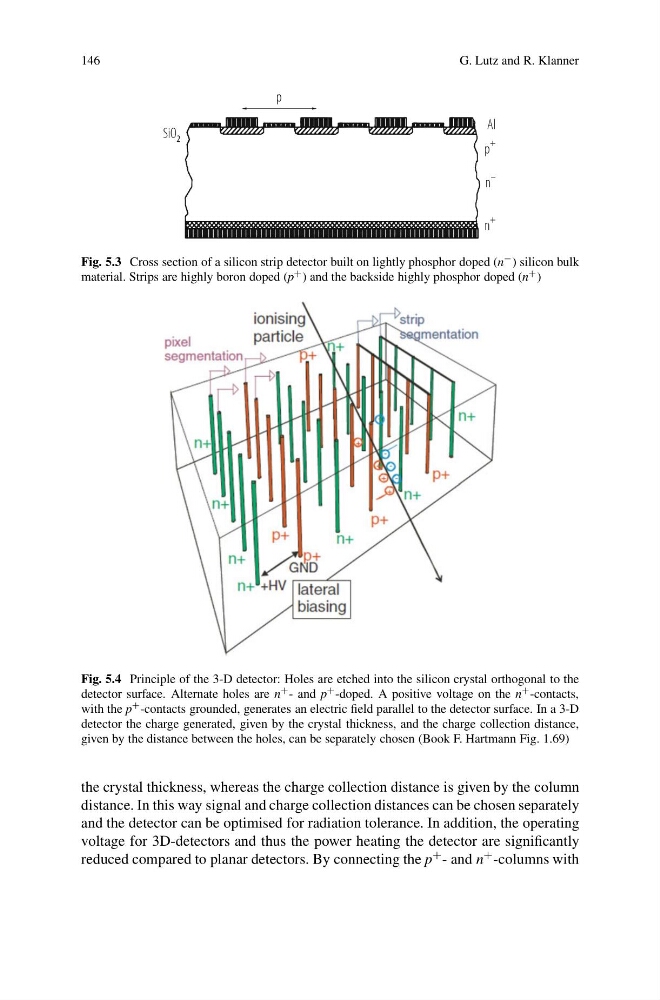
Fig. 5.3 Cross section of a silicon strip detector built on lightly phosphor doped (n − ) silicon bulk
material. Strips are highly boron doped (p + ) and the backside highly phosphor doped (n + )
Fig. 5.4 Principle of the 3-D detector: Holes are etched into the silicon crystal orthogonal to the
detector surface. Alternate holes are n + - and p + -doped. A positive voltage on the n + -contacts,
with the p + -contacts grounded, generates an electric field parallel to the detector surface. In a 3-D
detector the charge generated, given by the crystal thickness, and the charge collection distance,
given by the distance between the holes, can be separately chosen (Book F. Hartmann Fig. 1.69)
the crystal thickness, whereas the charge collection distance is given by the column
distance. In this way signal and charge collection distances can be chosen separately
and the detector can be optimised for radiation tolerance. In addition, the operating
voltage for 3D-detectors and thus the power heating the detector are significantly
reduced compared to planar detectors. By connecting the p + - and n + -columns with
G. Lutz and R. Klanner
Fig. 5.3 Cross section of a silicon strip detector built on lightly phosphor doped (n − ) silicon bulk
material. Strips are highly boron doped (p + ) and the backside highly phosphor doped (n + )
Fig. 5.4 Principle of the 3-D detector: Holes are etched into the silicon crystal orthogonal to the
detector surface. Alternate holes are n + - and p + -doped. A positive voltage on the n + -contacts,
with the p + -contacts grounded, generates an electric field parallel to the detector surface. In a 3-D
detector the charge generated, given by the crystal thickness, and the charge collection distance,
given by the distance between the holes, can be separately chosen (Book F. Hartmann Fig. 1.69)
the crystal thickness, whereas the charge collection distance is given by the column
distance. In this way signal and charge collection distances can be chosen separately
and the detector can be optimised for radiation tolerance. In addition, the operating
voltage for 3D-detectors and thus the power heating the detector are significantly
reduced compared to planar detectors. By connecting the p + - and n + -columns with