

48
H. B. N. Yongsi
0% 10% 20% 30% 40% 50% 60% 70% 80% 90%
No light
Unhealthyness
Risk of rape
Built with precarious materials
No separaƟon between men and women
Senegal --Niger 55%
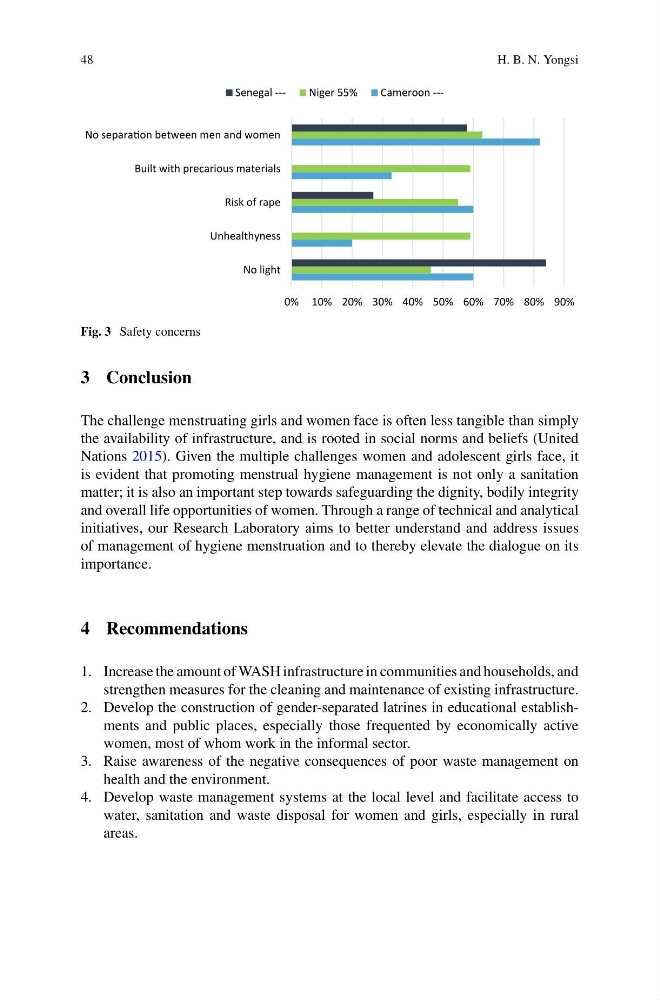
Cameroon --Fig. 3 Safety concerns
3 Conclusion
The challenge menstruating girls and women face is often less tangible than simply
the availability of infrastructure, and is rooted in social norms and beliefs (United
Nations 2015). Given the multiple challenges women and adolescent girls face, it
is evident that promoting menstrual hygiene management is not only a sanitation
matter; it is also an important step towards safeguarding the dignity, bodily integrity
and overall life opportunities of women. Through a range of technical and analytical
initiatives, our Research Laboratory aims to better understand and address issues
of management of hygiene menstruation and to thereby elevate the dialogue on its
importance.
4 Recommendations
1. Increase the amount of WASH infrastructure in communities and households, and
strengthen measures for the cleaning and maintenance of existing infrastructure.
2. Develop the construction of gender-separated latrines in educational establishments and public places, especially those frequented by economically active
women, most of whom work in the informal sector.
3. Raise awareness of the negative consequences of poor waste management on
health and the environment.
4. Develop waste management systems at the local level and facilitate access to
water, sanitation and waste disposal for women and girls, especially in rural
areas.
H. B. N. Yongsi
0% 10% 20% 30% 40% 50% 60% 70% 80% 90%
No light
Unhealthyness
Risk of rape
Built with precarious materials
No separaƟon between men and women
Senegal --Niger 55%
Cameroon --Fig. 3 Safety concerns
3 Conclusion
The challenge menstruating girls and women face is often less tangible than simply
the availability of infrastructure, and is rooted in social norms and beliefs (United
Nations 2015). Given the multiple challenges women and adolescent girls face, it
is evident that promoting menstrual hygiene management is not only a sanitation
matter; it is also an important step towards safeguarding the dignity, bodily integrity
and overall life opportunities of women. Through a range of technical and analytical
initiatives, our Research Laboratory aims to better understand and address issues
of management of hygiene menstruation and to thereby elevate the dialogue on its
importance.
4 Recommendations
1. Increase the amount of WASH infrastructure in communities and households, and
strengthen measures for the cleaning and maintenance of existing infrastructure.
2. Develop the construction of gender-separated latrines in educational establishments and public places, especially those frequented by economically active
women, most of whom work in the informal sector.
3. Raise awareness of the negative consequences of poor waste management on
health and the environment.
4. Develop waste management systems at the local level and facilitate access to
water, sanitation and waste disposal for women and girls, especially in rural
areas.