

32
C. Daher et al.
3.3 Physical Activity
Urban transport planning influences citizens’ physical activity. A sedentary lifestyle
is the fourth risk factor for global mortality and is associated with 6% of deaths
worldwide (World Health Organization 2018). Enabling physical activity is even
more urgently needed during the pandemic to minimize negative health impacts.
Among many health benefits from physical activity are an enhanced immune system
and a stabilization effect on mental health, two aspects that have been shown to
be particularly affected by COVID-19 and the associated confinement restrictions
(ISGlobal
1 2020; ISGlobal
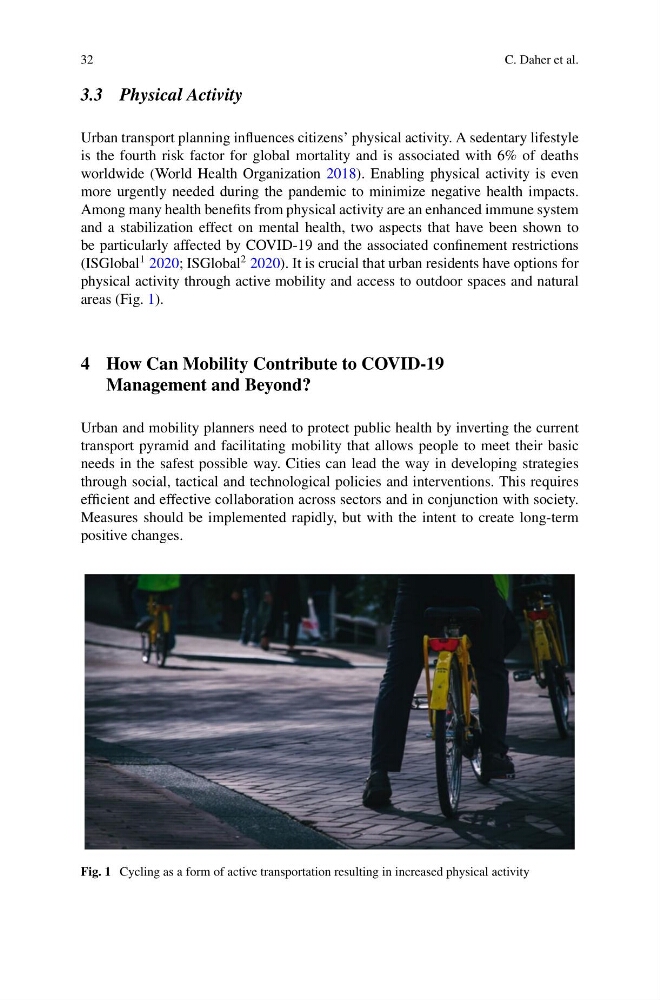
2 2020). It is crucial that urban residents have options for
physical activity through active mobility and access to outdoor spaces and natural
areas (Fig. 1).
4 How Can Mobility Contribute to COVID-19
Management and Beyond?
Urban and mobility planners need to protect public health by inverting the current
transport pyramid and facilitating mobility that allows people to meet their basic
needs in the safest possible way. Cities can lead the way in developing strategies
through social, tactical and technological policies and interventions. This requires
efficient and effective collaboration across sectors and in conjunction with society.
Measures should be implemented rapidly, but with the intent to create long-term
positive changes.
Fig. 1 Cycling as a form of active transportation resulting in increased physical activity
C. Daher et al.
3.3 Physical Activity
Urban transport planning influences citizens’ physical activity. A sedentary lifestyle
is the fourth risk factor for global mortality and is associated with 6% of deaths
worldwide (World Health Organization 2018). Enabling physical activity is even
more urgently needed during the pandemic to minimize negative health impacts.
Among many health benefits from physical activity are an enhanced immune system
and a stabilization effect on mental health, two aspects that have been shown to
be particularly affected by COVID-19 and the associated confinement restrictions
(ISGlobal
1 2020; ISGlobal
2 2020). It is crucial that urban residents have options for
physical activity through active mobility and access to outdoor spaces and natural
areas (Fig. 1).
4 How Can Mobility Contribute to COVID-19
Management and Beyond?
Urban and mobility planners need to protect public health by inverting the current
transport pyramid and facilitating mobility that allows people to meet their basic
needs in the safest possible way. Cities can lead the way in developing strategies
through social, tactical and technological policies and interventions. This requires
efficient and effective collaboration across sectors and in conjunction with society.
Measures should be implemented rapidly, but with the intent to create long-term
positive changes.
Fig. 1 Cycling as a form of active transportation resulting in increased physical activity