

26
A. Bakhtawar
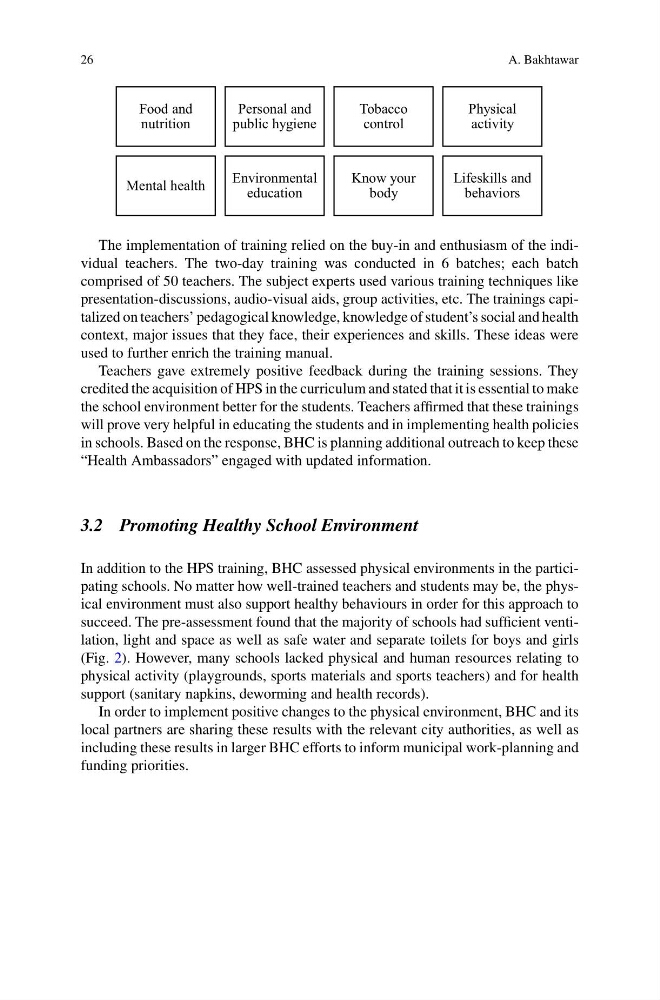
Food and
nutrition
Personal and
public hygiene
Tobacco
control
Physical
activity
Mental health
Environmental
education
Know your
body
Lifeskills and
behaviors
The implementation of training relied on the buy-in and enthusiasm of the individual teachers. The two-day training was conducted in 6 batches; each batch
comprised of 50 teachers. The subject experts used various training techniques like
presentation-discussions, audio-visual aids, group activities, etc. The trainings capitalized on teachers’ pedagogical knowledge, knowledge of student’s social and health
context, major issues that they face, their experiences and skills. These ideas were
used to further enrich the training manual.
Teachers gave extremely positive feedback during the training sessions. They
credited the acquisition of HPS in the curriculum and stated that it is essential to make
the school environment better for the students. Teachers affirmed that these trainings
will prove very helpful in educating the students and in implementing health policies
in schools. Based on the response, BHC is planning additional outreach to keep these
“Health Ambassadors” engaged with updated information.
3.2 Promoting Healthy School Environment
In addition to the HPS training, BHC assessed physical environments in the participating schools. No matter how well-trained teachers and students may be, the physical environment must also support healthy behaviours in order for this approach to
succeed. The pre-assessment found that the majority of schools had sufficient ventilation, light and space as well as safe water and separate toilets for boys and girls
(Fig. 2). However, many schools lacked physical and human resources relating to
physical activity (playgrounds, sports materials and sports teachers) and for health
support (sanitary napkins, deworming and health records).
In order to implement positive changes to the physical environment, BHC and its
local partners are sharing these results with the relevant city authorities, as well as
including these results in larger BHC efforts to inform municipal work-planning and
funding priorities.
A. Bakhtawar
Food and
nutrition
Personal and
public hygiene
Tobacco
control
Physical
activity
Mental health
Environmental
education
Know your
body
Lifeskills and
behaviors
The implementation of training relied on the buy-in and enthusiasm of the individual teachers. The two-day training was conducted in 6 batches; each batch
comprised of 50 teachers. The subject experts used various training techniques like
presentation-discussions, audio-visual aids, group activities, etc. The trainings capitalized on teachers’ pedagogical knowledge, knowledge of student’s social and health
context, major issues that they face, their experiences and skills. These ideas were
used to further enrich the training manual.
Teachers gave extremely positive feedback during the training sessions. They
credited the acquisition of HPS in the curriculum and stated that it is essential to make
the school environment better for the students. Teachers affirmed that these trainings
will prove very helpful in educating the students and in implementing health policies
in schools. Based on the response, BHC is planning additional outreach to keep these
“Health Ambassadors” engaged with updated information.
3.2 Promoting Healthy School Environment
In addition to the HPS training, BHC assessed physical environments in the participating schools. No matter how well-trained teachers and students may be, the physical environment must also support healthy behaviours in order for this approach to
succeed. The pre-assessment found that the majority of schools had sufficient ventilation, light and space as well as safe water and separate toilets for boys and girls
(Fig. 2). However, many schools lacked physical and human resources relating to
physical activity (playgrounds, sports materials and sports teachers) and for health
support (sanitary napkins, deworming and health records).
In order to implement positive changes to the physical environment, BHC and its
local partners are sharing these results with the relevant city authorities, as well as
including these results in larger BHC efforts to inform municipal work-planning and
funding priorities.