

Current and Future Human Exposure to High …
9
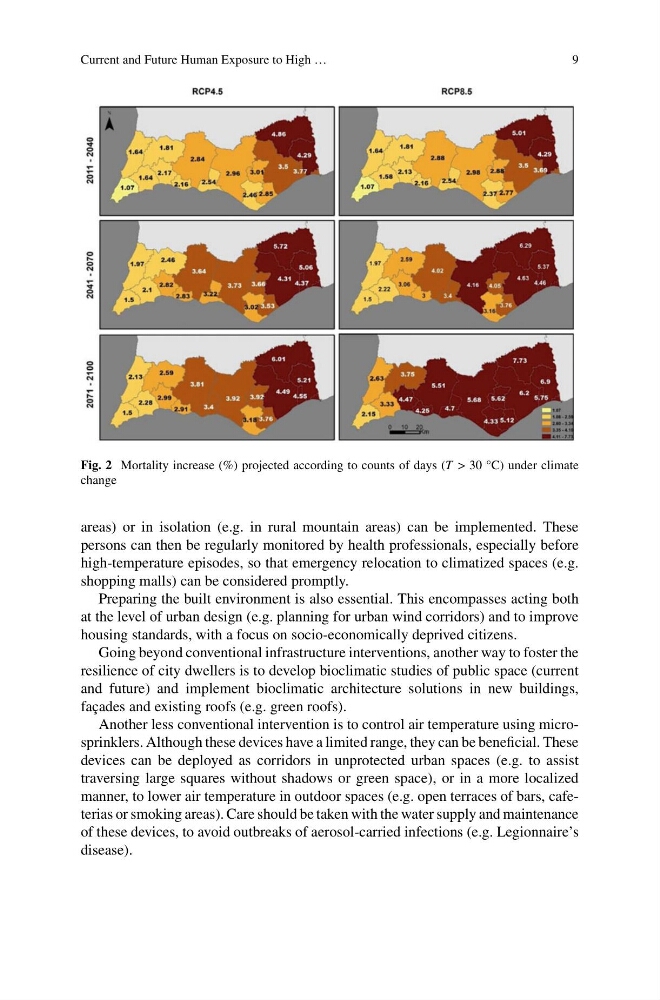
Fig. 2 Mortality increase (%) projected according to counts of days (T > 30 °C) under climate
change
areas) or in isolation (e.g. in rural mountain areas) can be implemented. These
persons can then be regularly monitored by health professionals, especially before
high-temperature episodes, so that emergency relocation to climatized spaces (e.g.
shopping malls) can be considered promptly.
Preparing the built environment is also essential. This encompasses acting both
at the level of urban design (e.g. planning for urban wind corridors) and to improve
housing standards, with a focus on socio-economically deprived citizens.
Going beyond conventional infrastructure interventions, another way to foster the
resilience of city dwellers is to develop bioclimatic studies of public space (current
and future) and implement bioclimatic architecture solutions in new buildings,
façades and existing roofs (e.g. green roofs).
Another less conventional intervention is to control air temperature using microsprinklers. Although these devices have a limited range, they can be beneficial. These
devices can be deployed as corridors in unprotected urban spaces (e.g. to assist
traversing large squares without shadows or green space), or in a more localized
manner, to lower air temperature in outdoor spaces (e.g. open terraces of bars, cafeterias or smoking areas). Care should be taken with the water supply and maintenance
of these devices, to avoid outbreaks of aerosol-carried infections (e.g. Legionnaire’s
disease).
9
Fig. 2 Mortality increase (%) projected according to counts of days (T > 30 °C) under climate
change
areas) or in isolation (e.g. in rural mountain areas) can be implemented. These
persons can then be regularly monitored by health professionals, especially before
high-temperature episodes, so that emergency relocation to climatized spaces (e.g.
shopping malls) can be considered promptly.
Preparing the built environment is also essential. This encompasses acting both
at the level of urban design (e.g. planning for urban wind corridors) and to improve
housing standards, with a focus on socio-economically deprived citizens.
Going beyond conventional infrastructure interventions, another way to foster the
resilience of city dwellers is to develop bioclimatic studies of public space (current
and future) and implement bioclimatic architecture solutions in new buildings,
façades and existing roofs (e.g. green roofs).
Another less conventional intervention is to control air temperature using microsprinklers. Although these devices have a limited range, they can be beneficial. These
devices can be deployed as corridors in unprotected urban spaces (e.g. to assist
traversing large squares without shadows or green space), or in a more localized
manner, to lower air temperature in outdoor spaces (e.g. open terraces of bars, cafeterias or smoking areas). Care should be taken with the water supply and maintenance
of these devices, to avoid outbreaks of aerosol-carried infections (e.g. Legionnaire’s
disease).