

3 Non-linear Dynamics in Accelerators
77
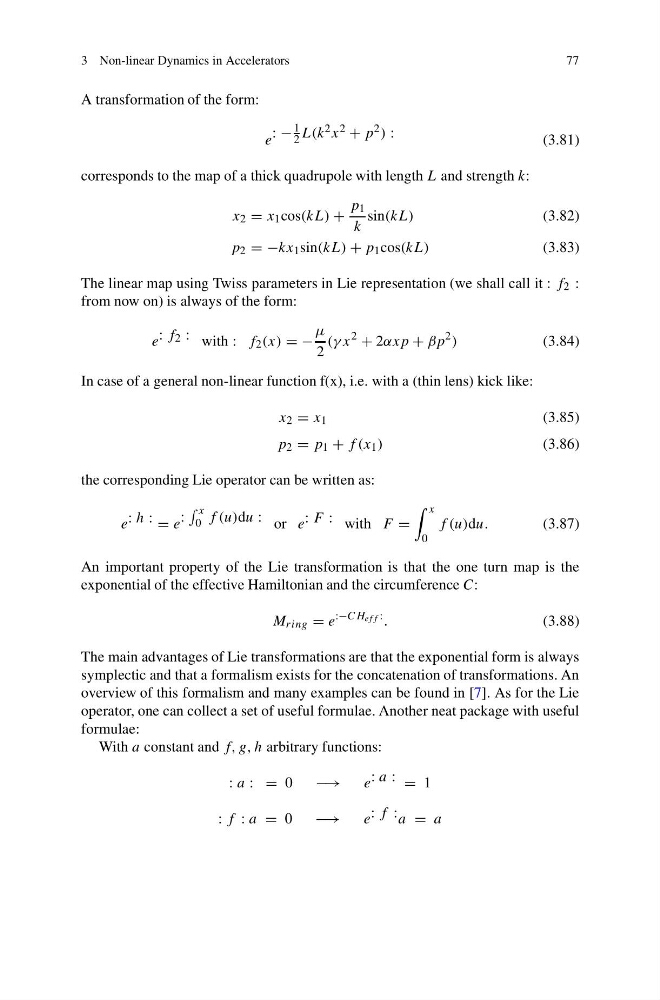
A transformation of the form:
e : −
1
2 L(k 2 x 2 + p 2 ) :
(3.81)
corresponds to the map of a thick quadrupole with length L and strength k:
x 2 = x 1 cos(kL) +
p 1
k
sin(kL)
(3.82)
p 2 = −kx 1 sin(kL) + p 1 cos(kL)
(3.83)
The linear map using Twiss parameters in Lie representation (we shall call it : f 2 :
from now on) is always of the form:
e : f 2 : with : f 2 (x) = −
μ
2
(γ x
2
+ 2αxp + βp
2 )
(3.84)
In case of a general non-linear function f(x), i.e. with a (thin lens) kick like:
x 2 = x 1
(3.85)
p 2 = p 1 + f (x 1 )
(3.86)
the corresponding Lie operator can be written as:
e : h : = e :
x
0 f (u)du : or e : F : with F =
x
0
f (u)du.
(3.87)
An important property of the Lie transformation is that the one turn map is the
exponential of the effective Hamiltonian and the circumference C:
M ring = e
:−CH eff : .
(3.88)
The main advantages of Lie transformations are that the exponential form is always
symplectic and that a formalism exists for the concatenation of transformations. An
overview of this formalism and many examples can be found in [7]. As for the Lie
operator, one can collect a set of useful formulae. Another neat package with useful
formulae:
With a constant and f, g, h arbitrary functions:
: a : = 0
−→
e : a : = 1
: f : a = 0
−→
e : f : a = a
77
A transformation of the form:
e : −
1
2 L(k 2 x 2 + p 2 ) :
(3.81)
corresponds to the map of a thick quadrupole with length L and strength k:
x 2 = x 1 cos(kL) +
p 1
k
sin(kL)
(3.82)
p 2 = −kx 1 sin(kL) + p 1 cos(kL)
(3.83)
The linear map using Twiss parameters in Lie representation (we shall call it : f 2 :
from now on) is always of the form:
e : f 2 : with : f 2 (x) = −
μ
2
(γ x
2
+ 2αxp + βp
2 )
(3.84)
In case of a general non-linear function f(x), i.e. with a (thin lens) kick like:
x 2 = x 1
(3.85)
p 2 = p 1 + f (x 1 )
(3.86)
the corresponding Lie operator can be written as:
e : h : = e :
x
0 f (u)du : or e : F : with F =
x
0
f (u)du.
(3.87)
An important property of the Lie transformation is that the one turn map is the
exponential of the effective Hamiltonian and the circumference C:
M ring = e
:−CH eff : .
(3.88)
The main advantages of Lie transformations are that the exponential form is always
symplectic and that a formalism exists for the concatenation of transformations. An
overview of this formalism and many examples can be found in [7]. As for the Lie
operator, one can collect a set of useful formulae. Another neat package with useful
formulae:
With a constant and f, g, h arbitrary functions:
: a : = 0
−→
e : a : = 1
: f : a = 0
−→
e : f : a = a