

11 Application of Accelerators and Storage Rings
761
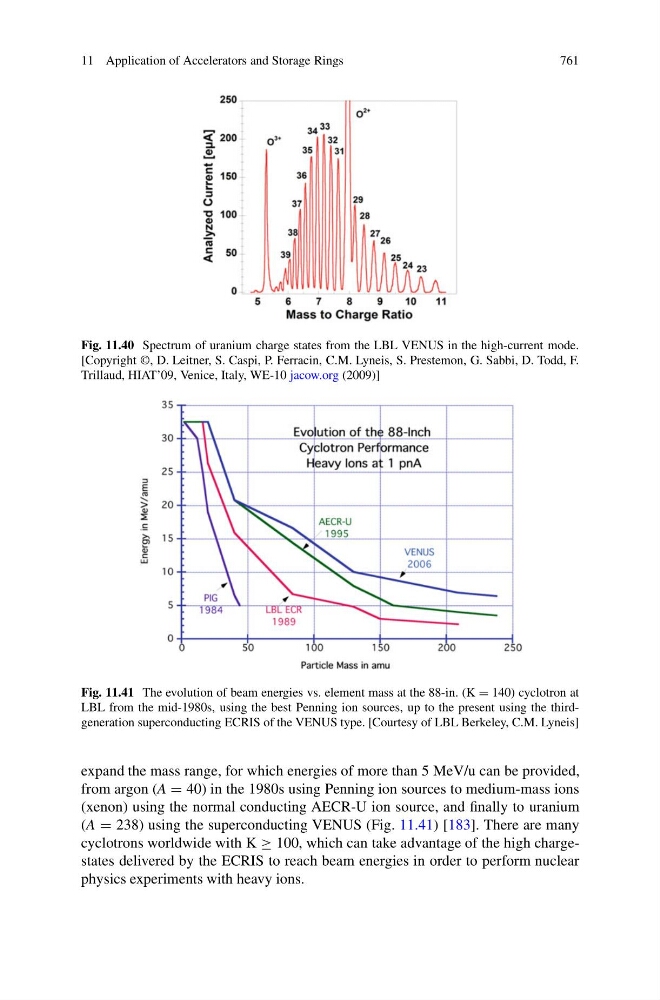
Fig. 11.40 Spectrum of uranium charge states from the LBL VENUS in the high-current mode.
[Copyright ©, D. Leitner, S. Caspi, P. Ferracin, C.M. Lyneis, S. Prestemon, G. Sabbi, D. Todd, F.
Trillaud, HIAT’09, Venice, Italy, WE-10 jacow.org (2009)]
Fig. 11.41 The evolution of beam energies vs. element mass at the 88-in. (K = 140) cyclotron at
LBL from the mid-1980s, using the best Penning ion sources, up to the present using the thirdgeneration superconducting ECRIS of the VENUS type. [Courtesy of LBL Berkeley, C.M. Lyneis]
expand the mass range, for which energies of more than 5 MeV/u can be provided,
from argon (A = 40) in the 1980s using Penning ion sources to medium-mass ions
(xenon) using the normal conducting AECR-U ion source, and finally to uranium
(A = 238) using the superconducting VENUS (Fig. 11.41) [183]. There are many
cyclotrons worldwide with K ≥ 100, which can take advantage of the high chargestates delivered by the ECRIS to reach beam energies in order to perform nuclear
physics experiments with heavy ions.