

11 Application of Accelerators and Storage Rings
757
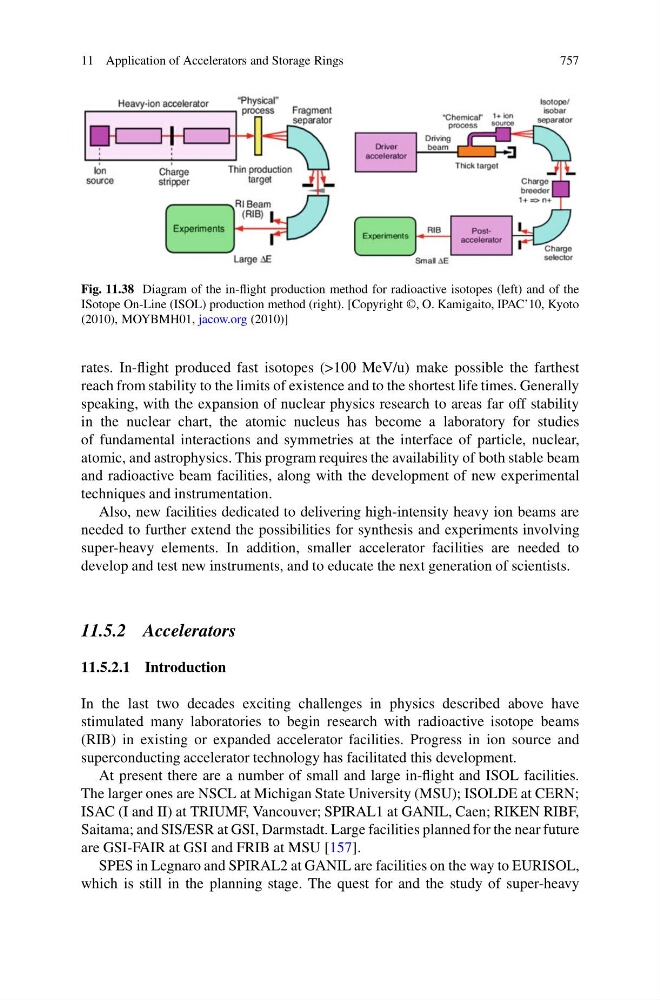
Fig. 11.38 Diagram of the in-flight production method for radioactive isotopes (left) and of the
ISotope On-Line (ISOL) production method (right). [Copyright ©, O. Kamigaito, IPAC’10, Kyoto
(2010), MOYBMH01, jacow.org (2010)]
rates. In-flight produced fast isotopes (>100 MeV/u) make possible the farthest
reach from stability to the limits of existence and to the shortest life times. Generally
speaking, with the expansion of nuclear physics research to areas far off stability
in the nuclear chart, the atomic nucleus has become a laboratory for studies
of fundamental interactions and symmetries at the interface of particle, nuclear,
atomic, and astrophysics. This program requires the availability of both stable beam
and radioactive beam facilities, along with the development of new experimental
techniques and instrumentation.
Also, new facilities dedicated to delivering high-intensity heavy ion beams are
needed to further extend the possibilities for synthesis and experiments involving
super-heavy elements. In addition, smaller accelerator facilities are needed to
develop and test new instruments, and to educate the next generation of scientists.
11.5.2 Accelerators
11.5.2.1 Introduction
In the last two decades exciting challenges in physics described above have
stimulated many laboratories to begin research with radioactive isotope beams
(RIB) in existing or expanded accelerator facilities. Progress in ion source and
superconducting accelerator technology has facilitated this development.
At present there are a number of small and large in-flight and ISOL facilities.
The larger ones are NSCL at Michigan State University (MSU); ISOLDE at CERN;
ISAC (I and II) at TRIUMF, Vancouver; SPIRAL1 at GANIL, Caen; RIKEN RIBF,
Saitama; and SIS/ESR at GSI, Darmstadt. Large facilities planned for the near future
are GSI-FAIR at GSI and FRIB at MSU [157].
SPES in Legnaro and SPIRAL2 at GANIL are facilities on the way to EURISOL,
which is still in the planning stage. The quest for and the study of super-heavy