

756
M. Dohlus et al.
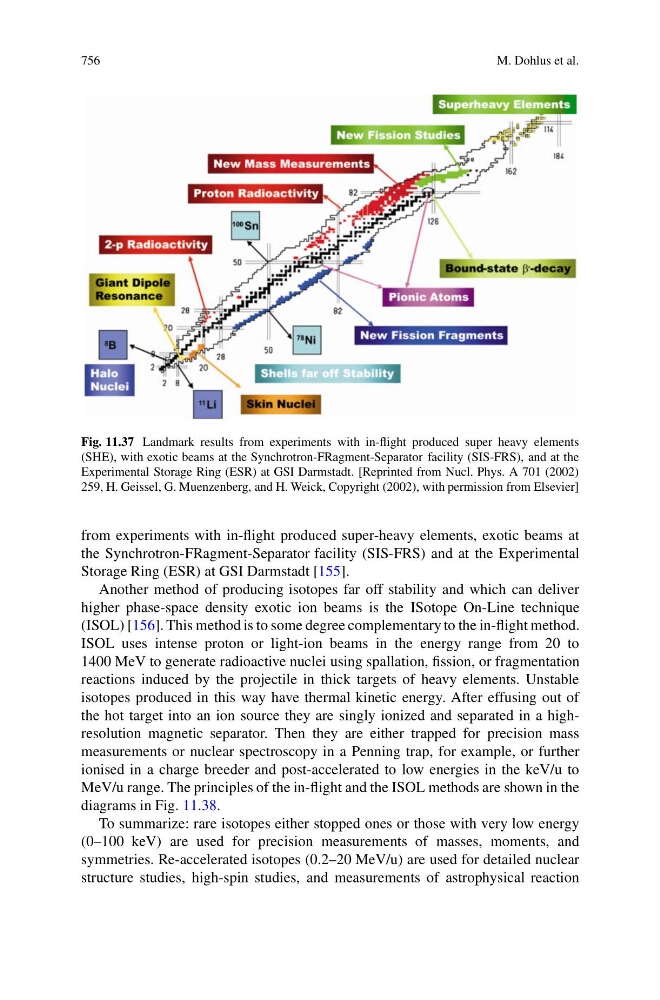
Fig. 11.37 Landmark results from experiments with in-flight produced super heavy elements
(SHE), with exotic beams at the Synchrotron-FRagment-Separator facility (SIS-FRS), and at the
Experimental Storage Ring (ESR) at GSI Darmstadt. [Reprinted from Nucl. Phys. A 701 (2002)
259, H. Geissel, G. Muenzenberg, and H. Weick, Copyright (2002), with permission from Elsevier]
from experiments with in-flight produced super-heavy elements, exotic beams at
the Synchrotron-FRagment-Separator facility (SIS-FRS) and at the Experimental
Storage Ring (ESR) at GSI Darmstadt [155].
Another method of producing isotopes far off stability and which can deliver
higher phase-space density exotic ion beams is the ISotope On-Line technique
(ISOL) [156]. This method is to some degree complementary to the in-flight method.
ISOL uses intense proton or light-ion beams in the energy range from 20 to
1400 MeV to generate radioactive nuclei using spallation, fission, or fragmentation
reactions induced by the projectile in thick targets of heavy elements. Unstable
isotopes produced in this way have thermal kinetic energy. After effusing out of
the hot target into an ion source they are singly ionized and separated in a highresolution magnetic separator. Then they are either trapped for precision mass
measurements or nuclear spectroscopy in a Penning trap, for example, or further
ionised in a charge breeder and post-accelerated to low energies in the keV/u to
MeV/u range. The principles of the in-flight and the ISOL methods are shown in the
diagrams in Fig. 11.38.
To summarize: rare isotopes either stopped ones or those with very low energy
(0–100 keV) are used for precision measurements of masses, moments, and
symmetries. Re-accelerated isotopes (0.2–20 MeV/u) are used for detailed nuclear
structure studies, high-spin studies, and measurements of astrophysical reaction