

752
M. Dohlus et al.
During the course of acceleration the revolution time of the beam must be kept
constant in order to ensure synchronicity with the accelerating RF voltage. At
relativistic energies this is achieved by raising the average magnetic bending field in
proportion to the relativistic γ factor towards larger orbit radii. This positive slope
of the bending field as a function of radius would result in a loss of vertical focusing
if the field was uniform azimuthally. Sufficient focusing is achieved due to the
azimuthally varying field strength in sector magnets and intermittent gaps (Thomas
focusing [141]), and by the introduction of spiral magnet shapes that enhance the
edge focusing effect of the bending magnets.
In practice the strength of vertical focusing is typically just sufficient for
operation, but weak in comparison with alternate gradient focusing. In the PSI
Ring cyclotron the number of vertical betatron oscillations per turn is slightly
smaller than 1 which reflects the weak focusing properties of the cyclotron magnet
lattice.
The key for the acceleration of a high intensity beam in a cyclotron is a clean
extraction with small losses. In the PSI cyclotron the extraction is realized by
deflecting the beam with an electrostatic element whose 50 μm tungsten electrode
has to be placed between last and second last turn. Particles in the beam halo
may hit this electrode, are scattered out of the beam and are lost in the extraction
beamline. According to practical experience losses of the order of 100 W can be
accepted with respect to this major loss mechanism in the PSI facility. The highest
activation levels in the extraction beamline typically amount to 10 mSv/h. All efforts
to optimize the accelerator towards higher beam powers are focused on lowering
the particle density in the beam tails and maximizing the turn separation at the
extraction point. One dominating effect generating beam tails is the longitudinal
space charge force which increases the correlated energy spread inside the bunch.
The bending fields transform the energy spread finally into transverse beam tails that
may interact with the extraction electrode. As Joho has shown [142], the strength
of this effect scales quadratically with the time the beam needs to be accelerated,
i.e. with the number of turns. In addition turn separation at the extraction of the
cyclotron scales inversely with the number of turns. Thus in total the losses caused
by longitudinal space charge scale with the third power of the turn number. Because
of this strong scaling it is very beneficial to realize the highest possible accelerating
voltages. For a cyclotron designed purposely for high intensity beams the achievable
radius increment per turn is an important design criterion. Under the condition of
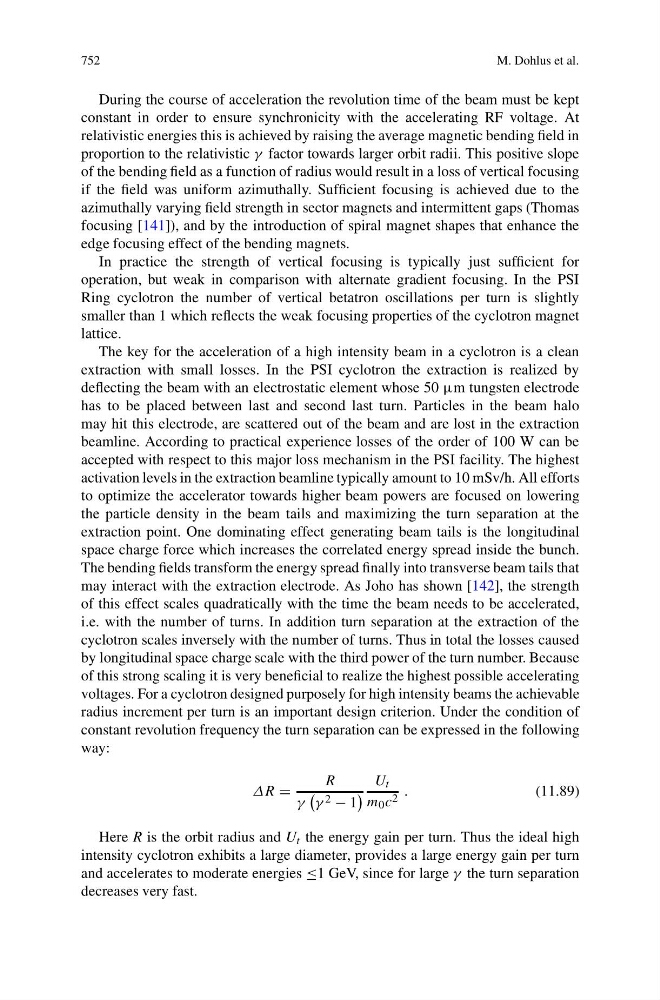
constant revolution frequency the turn separation can be expressed in the following
way:
ΔR =
R
γ
γ 2 − 1
U t
m 0 c 2 .
(11.89)
Here R is the orbit radius and U t the energy gain per turn. Thus the ideal high
intensity cyclotron exhibits a large diameter, provides a large energy gain per turn
and accelerates to moderate energies ≤1 GeV, since for large γ the turn separation
decreases very fast.