

11 Application of Accelerators and Storage Rings
751
the respective tunes, chromaticities and tune spreads, and so aid in obtaining beam
stability.
11.4.4 High Intensity Cyclotrons
Cyclotrons have a long history in accelerator physics and are used for a wide
range of medical, industrial and research applications [137]. First cyclotrons were
designed and built by Lawrence and Livingston [138] back in 1931. The cyclotron
is a resonant accelerator concept with several properties that make it well suited for
the acceleration of hadron beams with high average intensity.
As a circular accelerator the cyclotron repetitively uses the same accelerating
resonators and radio frequency (RF) sources, thereby utilizing these expensive
components in an effective and economical way. Cyclotrons allow continuous
injection, acceleration and extraction of a beam. Neither RF frequency nor magnetic
bending field must be cycled. The continuous wave (CW) operation results in
low bunch charges, which leads to moderate space charge effects in comparison
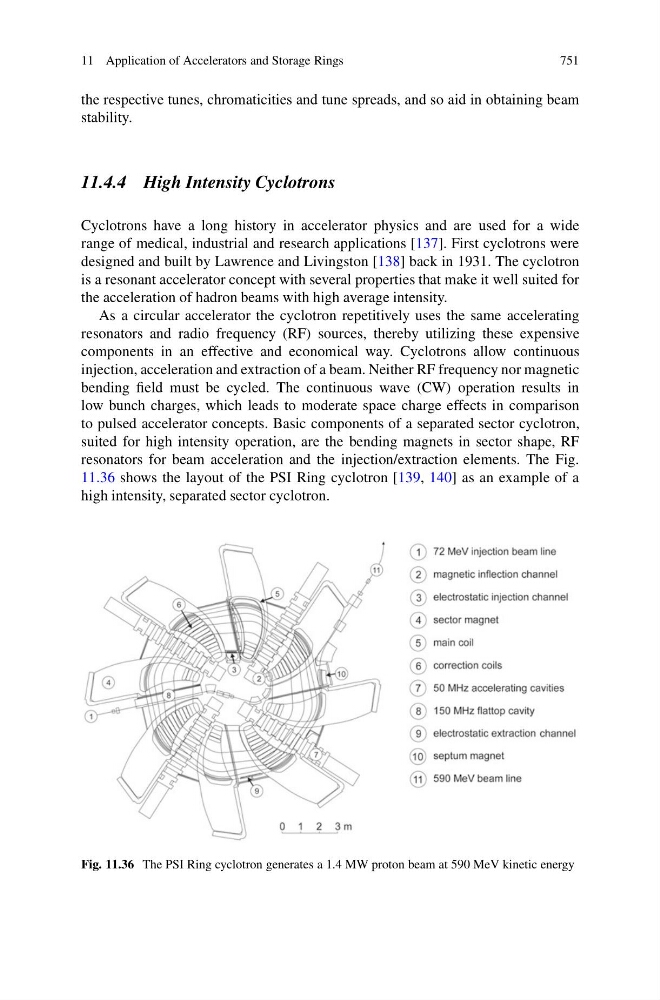
to pulsed accelerator concepts. Basic components of a separated sector cyclotron,
suited for high intensity operation, are the bending magnets in sector shape, RF
resonators for beam acceleration and the injection/extraction elements. The Fig.
11.36 shows the layout of the PSI Ring cyclotron [139, 140] as an example of a
high intensity, separated sector cyclotron.
Fig. 11.36 The PSI Ring cyclotron generates a 1.4 MW proton beam at 590 MeV kinetic energy