

11 Application of Accelerators and Storage Rings
741
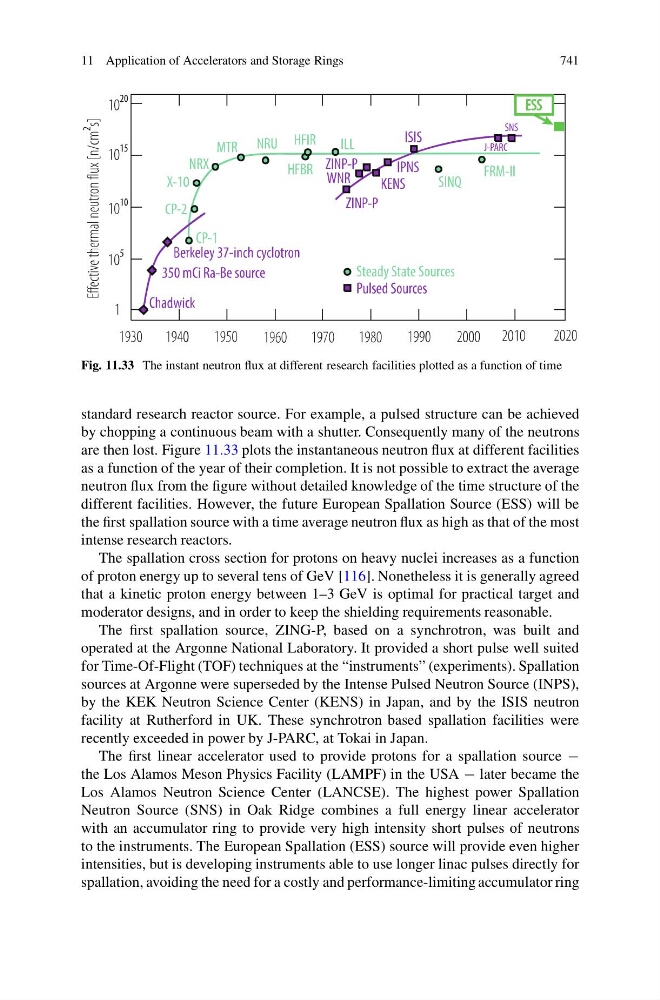
Fig. 11.33 The instant neutron flux at different research facilities plotted as a function of time
standard research reactor source. For example, a pulsed structure can be achieved
by chopping a continuous beam with a shutter. Consequently many of the neutrons
are then lost. Figure 11.33 plots the instantaneous neutron flux at different facilities
as a function of the year of their completion. It is not possible to extract the average
neutron flux from the figure without detailed knowledge of the time structure of the
different facilities. However, the future European Spallation Source (ESS) will be
the first spallation source with a time average neutron flux as high as that of the most
intense research reactors.
The spallation cross section for protons on heavy nuclei increases as a function
of proton energy up to several tens of GeV [116]. Nonetheless it is generally agreed
that a kinetic proton energy between 1–3 GeV is optimal for practical target and
moderator designs, and in order to keep the shielding requirements reasonable.
The first spallation source, ZING-P, based on a synchrotron, was built and
operated at the Argonne National Laboratory. It provided a short pulse well suited
for Time-Of-Flight (TOF) techniques at the “instruments” (experiments). Spallation
sources at Argonne were superseded by the Intense Pulsed Neutron Source (INPS),
by the KEK Neutron Science Center (KENS) in Japan, and by the ISIS neutron
facility at Rutherford in UK. These synchrotron based spallation facilities were
recently exceeded in power by J-PARC, at Tokai in Japan.
The first linear accelerator used to provide protons for a spallation source −
the Los Alamos Meson Physics Facility (LAMPF) in the USA − later became the
Los Alamos Neutron Science Center (LANCSE). The highest power Spallation
Neutron Source (SNS) in Oak Ridge combines a full energy linear accelerator
with an accumulator ring to provide very high intensity short pulses of neutrons
to the instruments. The European Spallation (ESS) source will provide even higher
intensities, but is developing instruments able to use longer linac pulses directly for
spallation, avoiding the need for a costly and performance-limiting accumulator ring