

740
M. Dohlus et al.
statistics and data on worldwide radioisotope production, to Eiichi Takada and
Hikaru Souda for the information about the recent developments on carbon-ion
therapy accelerators in Japan, and to Saverio Braccini for the precious contributions
and comments he provided on the text.
11.4 Spallation Sources
M. Lindroos · S. Molloy · G. Rees · M. Seidel
11.4.1 Introduction
Spallation is a nuclear process in which neutrons at different energies are emitted
in several stages following the bombardment of heavy nuclei with highly energetic
particles. In this chapter we limit ourselves to the description of the accelerator that
drives spallation sources. For a more detailed discussion of the spallation process
itself, the target, the moderators and the physics at such facilities see (for example)
[113]. However, it is worth noting that there are other ways to produce neutrons
with accelerators, for example photo-fission induced by an intense electron beam.
The spallation process is the most practical and feasible way of producing neutrons
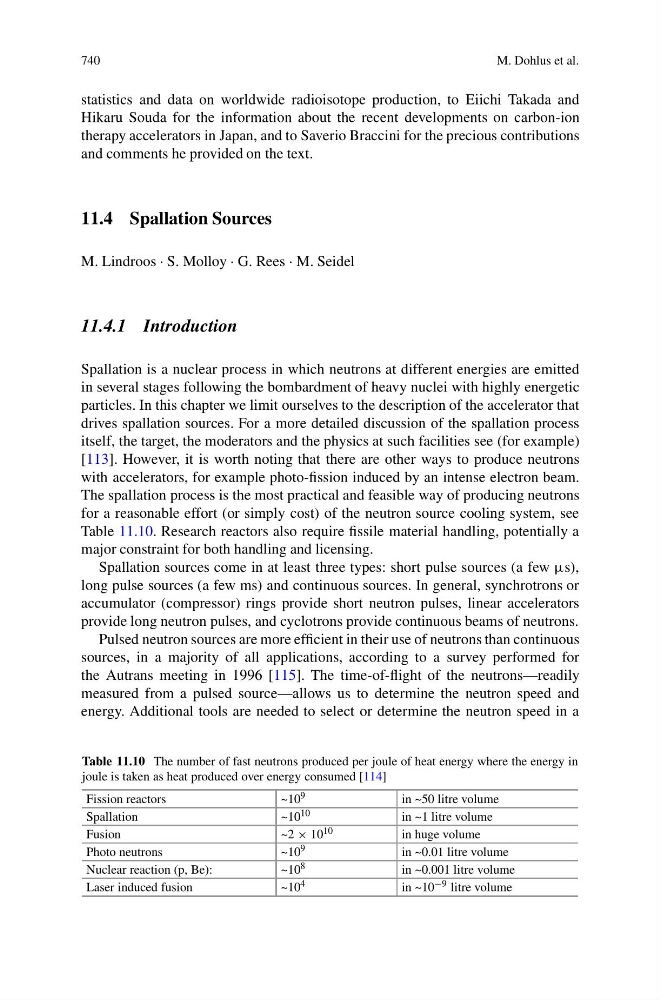
for a reasonable effort (or simply cost) of the neutron source cooling system, see
Table 11.10. Research reactors also require fissile material handling, potentially a
major constraint for both handling and licensing.
Spallation sources come in at least three types: short pulse sources (a few μs),
long pulse sources (a few ms) and continuous sources. In general, synchrotrons or
accumulator (compressor) rings provide short neutron pulses, linear accelerators
provide long neutron pulses, and cyclotrons provide continuous beams of neutrons.
Pulsed neutron sources are more efficient in their use of neutrons than continuous
sources, in a majority of all applications, according to a survey performed for
the Autrans meeting in 1996 [115]. The time-of-flight of the neutrons—readily
measured from a pulsed source—allows us to determine the neutron speed and
energy. Additional tools are needed to select or determine the neutron speed in a
Table 11.10 The number of fast neutrons produced per joule of heat energy where the energy in
joule is taken as heat produced over energy consumed [114]
Fission reactors
~10 9
in ~50 litre volume
Spallation
~10 10
in ~1 litre volume
Fusion
~2 × 10 10
in huge volume
Photo neutrons
~10 9
in ~0.01 litre volume
Nuclear reaction (p, Be):
~10 8
in ~0.001 litre volume
Laser induced fusion
~10 4
in ~10 −9 litre volume