

11 Application of Accelerators and Storage Rings
731
(at the Australian Bragg Centre for Proton Therapy and Research in Adelaide), and
in North Africa (at the Children’s Cancer Hospital Foundation, Cairo, Egypt).
Carbon-Ion Therapy
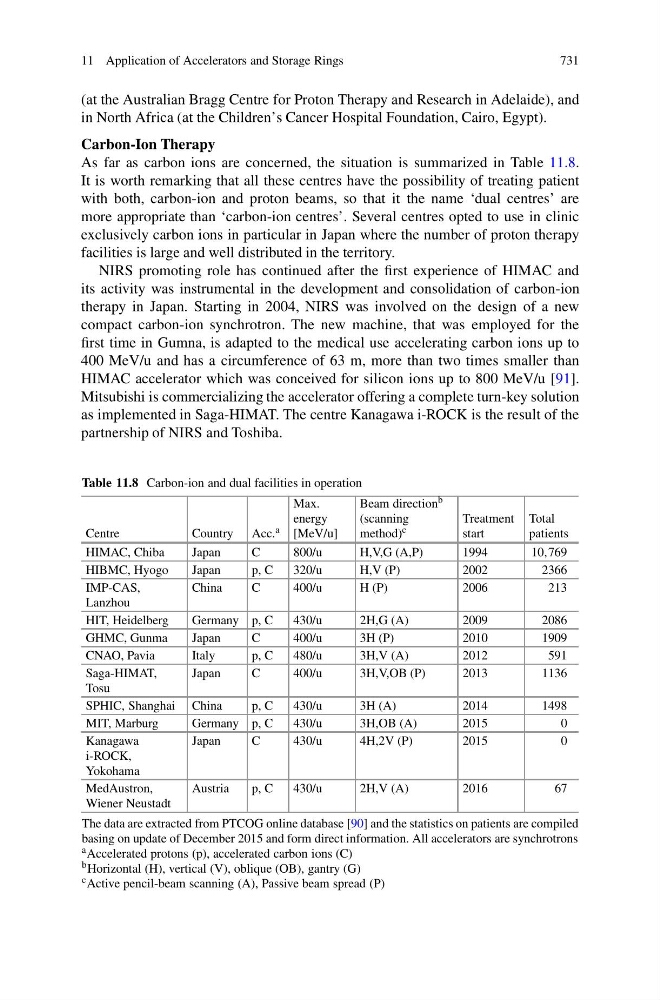
As far as carbon ions are concerned, the situation is summarized in Table 11.8.
It is worth remarking that all these centres have the possibility of treating patient
with both, carbon-ion and proton beams, so that it the name ‘dual centres’ are
more appropriate than ‘carbon-ion centres’. Several centres opted to use in clinic
exclusively carbon ions in particular in Japan where the number of proton therapy
facilities is large and well distributed in the territory.
NIRS promoting role has continued after the first experience of HIMAC and
its activity was instrumental in the development and consolidation of carbon-ion
therapy in Japan. Starting in 2004, NIRS was involved on the design of a new
compact carbon-ion synchrotron. The new machine, that was employed for the
first time in Gumna, is adapted to the medical use accelerating carbon ions up to
400 MeV/u and has a circumference of 63 m, more than two times smaller than
HIMAC accelerator which was conceived for silicon ions up to 800 MeV/u [91].
Mitsubishi is commercializing the accelerator offering a complete turn-key solution
as implemented in Saga-HIMAT. The centre Kanagawa i-ROCK is the result of the
partnership of NIRS and Toshiba.
Table 11.8 Carbon-ion and dual facilities in operation
Centre
Country Acc. a
Max.
energy
[MeV/u]
Beam direction b
(scanning
method) c
Treatment
start
Total
patients
HIMAC, Chiba
Japan
C
800/u
H,V,G (A,P)
1994
10,769
HIBMC, Hyogo
Japan
p, C
320/u
H,V (P)
2002
2366
IMP-CAS,
Lanzhou
China
C
400/u
H (P)
2006
213
HIT, Heidelberg
Germany p, C
430/u
2H,G (A)
2009
2086
GHMC, Gunma
Japan
C
400/u
3H (P)
2010
1909
CNAO, Pavia
Italy
p, C
480/u
3H,V (A)
2012
591
Saga-HIMAT,
Tosu
Japan
C
400/u
3H,V,OB (P)
2013
1136
SPHIC, Shanghai China
p, C
430/u
3H (A)
2014
1498
MIT, Marburg
Germany p, C
430/u
3H,OB (A)
2015
0
Kanagawa
i-ROCK,
Yokohama
Japan
C
430/u
4H,2V (P)
2015
0
MedAustron,
Wiener Neustadt
Austria
p, C
430/u
2H,V (A)
2016
67
The data are extracted from PTCOG online database [90] and the statistics on patients are compiled
basing on update of December 2015 and form direct information. All accelerators are synchrotrons
a Accelerated protons (p), accelerated carbon ions (C)
b Horizontal (H), vertical (V), oblique (OB), gantry (G)
c Active pencil-beam scanning (A), Passive beam spread (P)