

730
M. Dohlus et al.
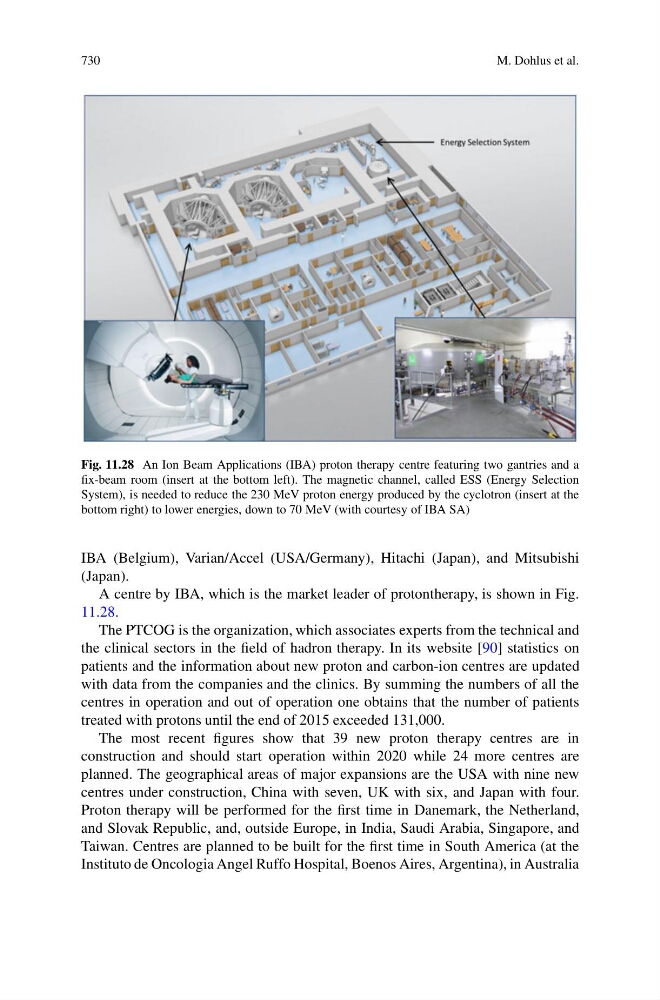
Fig. 11.28 An Ion Beam Applications (IBA) proton therapy centre featuring two gantries and a
fix-beam room (insert at the bottom left). The magnetic channel, called ESS (Energy Selection
System), is needed to reduce the 230 MeV proton energy produced by the cyclotron (insert at the
bottom right) to lower energies, down to 70 MeV (with courtesy of IBA SA)
IBA (Belgium), Varian/Accel (USA/Germany), Hitachi (Japan), and Mitsubishi
(Japan).
A centre by IBA, which is the market leader of protontherapy, is shown in Fig.
11.28.
The PTCOG is the organization, which associates experts from the technical and
the clinical sectors in the field of hadron therapy. In its website [90] statistics on
patients and the information about new proton and carbon-ion centres are updated
with data from the companies and the clinics. By summing the numbers of all the
centres in operation and out of operation one obtains that the number of patients
treated with protons until the end of 2015 exceeded 131,000.
The most recent figures show that 39 new proton therapy centres are in
construction and should start operation within 2020 while 24 more centres are
planned. The geographical areas of major expansions are the USA with nine new
centres under construction, China with seven, UK with six, and Japan with four.
Proton therapy will be performed for the first time in Danemark, the Netherland,
and Slovak Republic, and, outside Europe, in India, Saudi Arabia, Singapore, and
Taiwan. Centres are planned to be built for the first time in South America (at the
Instituto de Oncologia Angel Ruffo Hospital, Boenos Aires, Argentina), in Australia