

11 Application of Accelerators and Storage Rings
723
that need deposited doses 2–3 times higher if they are to be controlled with either
photons or protons (radiation oncologists speak of ‘Oxygen effect’). But problems
arose owing to non-tolerable side effects in the normal tissues. After the irradiations
of some 20 patients, Cornelius Tobias and collaborators decided to use lighter
ions, first silicon for 2 patients and then neon, for 433 patients. Only towards the
end of the program it was found that the neon charge (Z = 10) is too large and
undesirable effects were produced in the traversed and downstream healthy tissues
[79]. The Bevalac stopped operation in 1993 and, at the conclusion of this first phase
of hadrontherapy, almost 3600 patients have been treated worldwide with pions,
helium ions or other ions.
The larger effects that ions have with respect to the ones produced by cobalt60 gammas of identical dose is quantified by introducing the ‘RBE’ (Relative
Biological Effectiveness). RBE depends upon the cell type, the radiation used
(particle, energy, dose) and the chosen effect. For a given cell type and effect RBE
varies with the LET of the ionizing particles. Only at the beginning of the 1990s
carbon ions (Z = 6) were chosen as the optimal ion type. Indeed light ions produce
a radiation field which is qualitatively different from the ones due to either photons
or protons and succeed in controlling also radioresistant tumours.
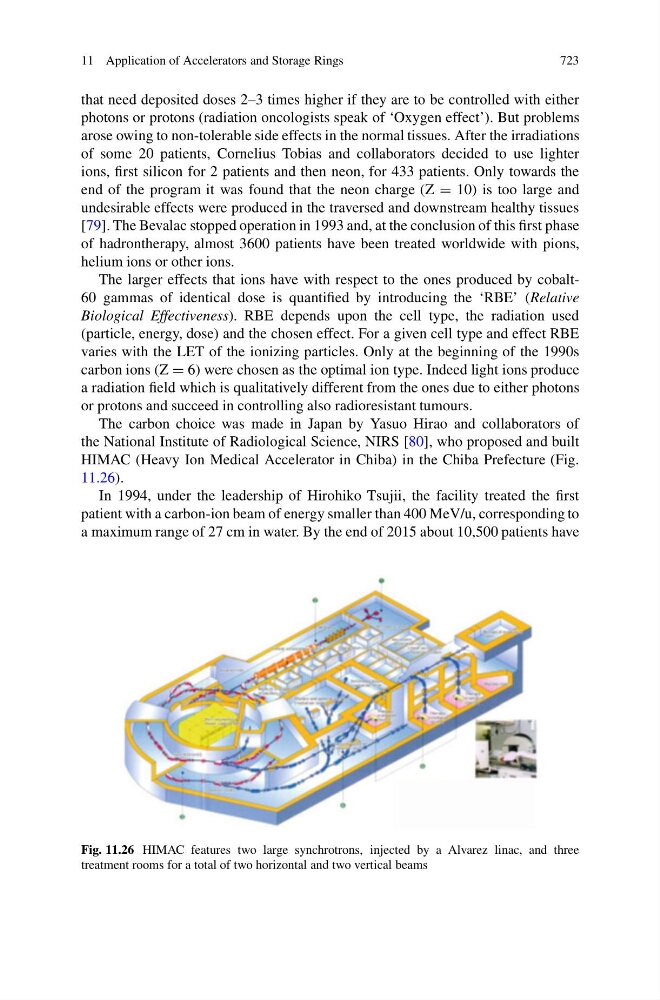
The carbon choice was made in Japan by Yasuo Hirao and collaborators of
the National Institute of Radiological Science, NIRS [80], who proposed and built
HIMAC (Heavy Ion Medical Accelerator in Chiba) in the Chiba Prefecture (Fig.
11.26).
In 1994, under the leadership of Hirohiko Tsujii, the facility treated the first
patient with a carbon-ion beam of energy smaller than 400 MeV/u, corresponding to
a maximum range of 27 cm in water. By the end of 2015 about 10,500 patients have
Fig. 11.26 HIMAC features two large synchrotrons, injected by a Alvarez linac, and three
treatment rooms for a total of two horizontal and two vertical beams