

722
M. Dohlus et al.
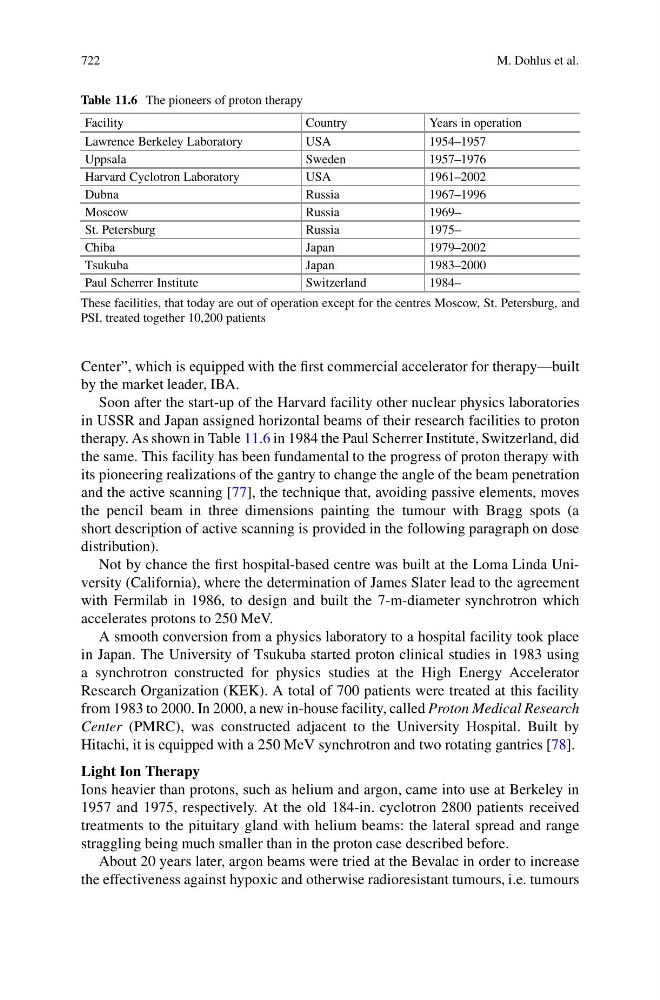
Table 11.6 The pioneers of proton therapy
Facility
Country
Years in operation
Lawrence Berkeley Laboratory
USA
1954–1957
Uppsala
Sweden
1957–1976
Harvard Cyclotron Laboratory
USA
1961–2002
Dubna
Russia
1967–1996
Moscow
Russia
1969–
St. Petersburg
Russia
1975–
Chiba
Japan
1979–2002
Tsukuba
Japan
1983–2000
Paul Scherrer Institute
Switzerland
1984–
These facilities, that today are out of operation except for the centres Moscow, St. Petersburg, and
PSI, treated together 10,200 patients
Center”, which is equipped with the first commercial accelerator for therapy—built
by the market leader, IBA.
Soon after the start-up of the Harvard facility other nuclear physics laboratories
in USSR and Japan assigned horizontal beams of their research facilities to proton
therapy. As shown in Table 11.6 in 1984 the Paul Scherrer Institute, Switzerland, did
the same. This facility has been fundamental to the progress of proton therapy with
its pioneering realizations of the gantry to change the angle of the beam penetration
and the active scanning [77], the technique that, avoiding passive elements, moves
the pencil beam in three dimensions painting the tumour with Bragg spots (a
short description of active scanning is provided in the following paragraph on dose
distribution).
Not by chance the first hospital-based centre was built at the Loma Linda University (California), where the determination of James Slater lead to the agreement
with Fermilab in 1986, to design and built the 7-m-diameter synchrotron which
accelerates protons to 250 MeV.
A smooth conversion from a physics laboratory to a hospital facility took place
in Japan. The University of Tsukuba started proton clinical studies in 1983 using
a synchrotron constructed for physics studies at the High Energy Accelerator
Research Organization (KEK). A total of 700 patients were treated at this facility
from 1983 to 2000. In 2000, a new in-house facility, called Proton Medical Research
Center (PMRC), was constructed adjacent to the University Hospital. Built by
Hitachi, it is equipped with a 250 MeV synchrotron and two rotating gantries [78].
Light Ion Therapy
Ions heavier than protons, such as helium and argon, came into use at Berkeley in
1957 and 1975, respectively. At the old 184-in. cyclotron 2800 patients received
treatments to the pituitary gland with helium beams: the lateral spread and range
straggling being much smaller than in the proton case described before.
About 20 years later, argon beams were tried at the Bevalac in order to increase
the effectiveness against hypoxic and otherwise radioresistant tumours, i.e. tumours