

11 Application of Accelerators and Storage Rings
711
simplified since it can be obtained with a thin stripping foil conveniently positioned
on the beam trajectory. In the foil all electrons are stripped leaving the protons,
positively charged, deviate to the opposite direction under the effect of the magnetic
field. The result is a clean extraction with efficiency very close to 100%. The
elimination of beam loss (of the order of 25% with normal extraction) drastically
reduces the activation of the cyclotron components simplifying the maintenance,
the regular inspection, and the decommissioning. A remarkable characteristic of
these cyclotrons is the possibility of obtaining simultaneous multiple beams making
partial extraction with additional more foils.
In recent years several companies entered into the production of cyclotrons,
machines that are stable, reliable, and can run continuously for days with limited
supervision and maintenance requirements. The accelerators design has been
adapted to the radiopharmaceutical request that is mainly concentrate on PET products. The cyclotrons dedicated to production of Fluorine-18, Carbon-11, Nitrogen13, and Oxygen-15, have abandoned the versatile characteristics of the traditional
machines and are made to accelerate only a specific ion (typically H − ), run at low
energy (20 MeV and below), and at relative low current (approximately 100 μA).
Commercial cyclotrons characteristics are chosen taking into account the halflife of the radionuclides they produced. For the optimal logistics the cyclotrons
should be homogeneously distributed in the territory with a large number of
small cyclotrons, 10 MeV and 20 MeV, to fulfill the requests of FDG and other
radiopharmaceuticals made on 18 F, 11 C, 13 N, 15 O, and a sparse distribution of
cyclotrons with wider range of energy, 30 MeV or 70 MeV, able to produce all
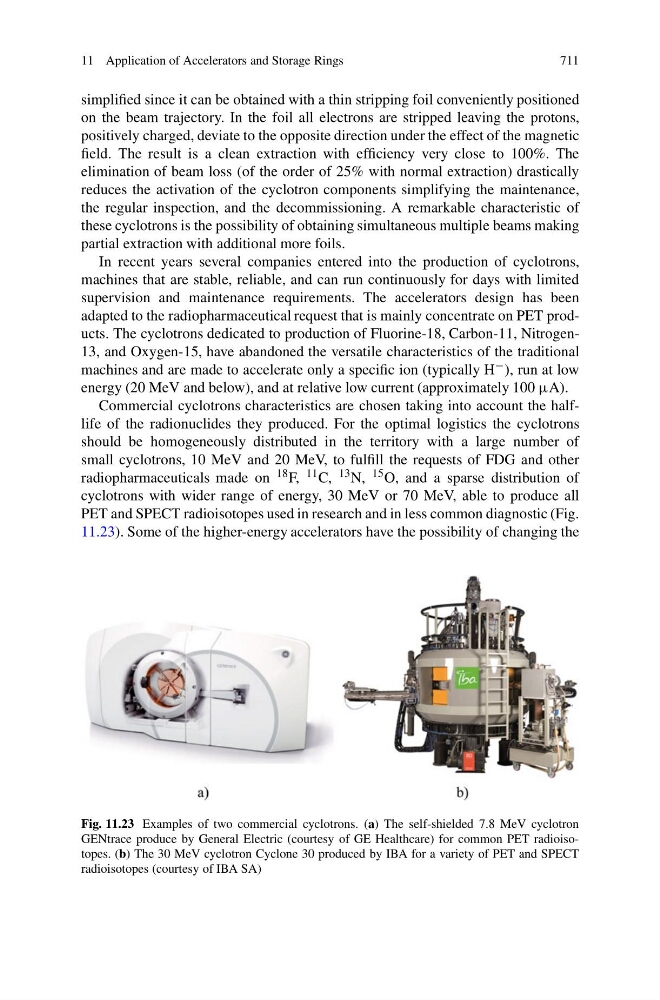
PET and SPECT radioisotopes used in research and in less common diagnostic (Fig.
11.23). Some of the higher-energy accelerators have the possibility of changing the
Fig. 11.23 Examples of two commercial cyclotrons. (a) The self-shielded 7.8 MeV cyclotron
GENtrace produce by General Electric (courtesy of GE Healthcare) for common PET radioisotopes. (b) The 30 MeV cyclotron Cyclone 30 produced by IBA for a variety of PET and SPECT
radioisotopes (courtesy of IBA SA)