

11 Application of Accelerators and Storage Rings
705
backscattering due to increase in cross section. Mass separation improves with
increasing beam energy. An increasing energy loss factor compared to light ions
leads to shallower profiling depths and superior potential depth resolution. All target
species heavier than the beam ion may be analyzed simultaneously.
The most frequently applied detector is the surface barrier detector. In some
installations time-of-flight detectors are used.
A further well established method is ERD (Elastic Recoil Detection) which is
also called Forward Recoil Spectrometry (FRES). In this process heavy projectiles
are used to measure the content of hydrogen. For that method an accelerator with
sufficiently high energy is required.
A general review of the methods of backscattering analysis is given e.g. by J.A.
Leavitt et al. in [41].
Many nuclear reactions are used for the analysis of materials. In particular, those
reactions which exhibit resonances in their excitation functions. By varying the
energy of the projectiles to excite these resonances and exploit their enhanced cross
sections, materials samples can be scanned with higher sensitivity.
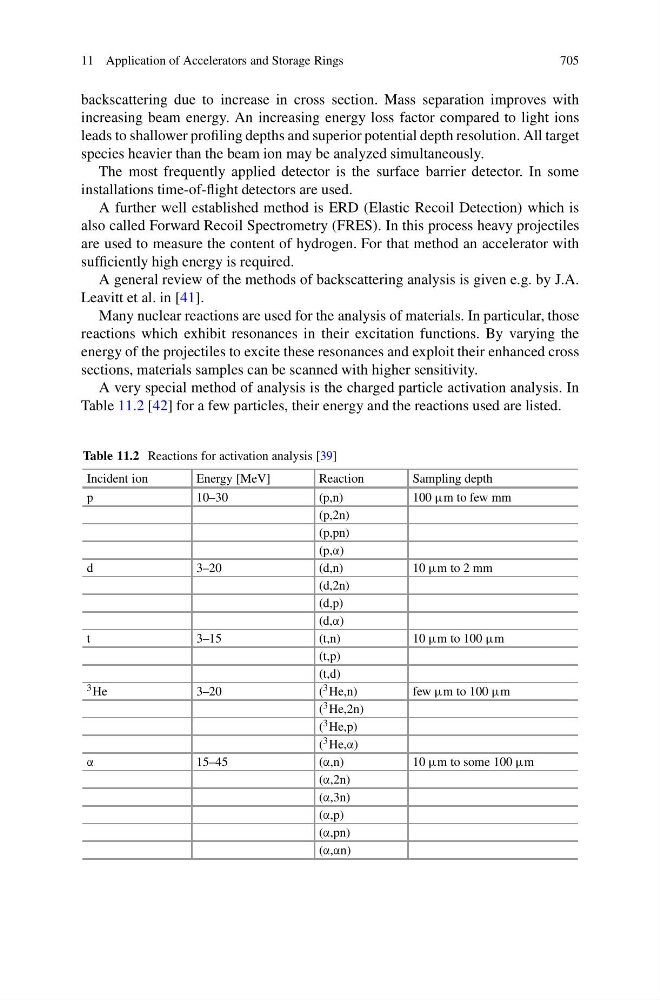
A very special method of analysis is the charged particle activation analysis. In
Table 11.2 [42] for a few particles, their energy and the reactions used are listed.
Table 11.2 Reactions for activation analysis [39]
Incident ion
Energy [MeV]
Reaction
Sampling depth
p
10–30
(p,n)
100 μm to few mm
(p,2n)
(p,pn)
(p,α)
d
3–20
(d,n)
10 μm to 2 mm
(d,2n)
(d,p)
(d,α)
t
3–15
(t,n)
10 μm to 100 μm
(t,p)
(t,d)
3 He
3–20
( 3 He,n)
few μm to 100 μm
( 3 He,2n)
( 3 He,p)
( 3 He,α)
α
15–45
(α,n)
10 μm to some 100 μm
(α,2n)
(α,3n)
(α,p)
(α,pn)
(α,αn)