

704
M. Dohlus et al.
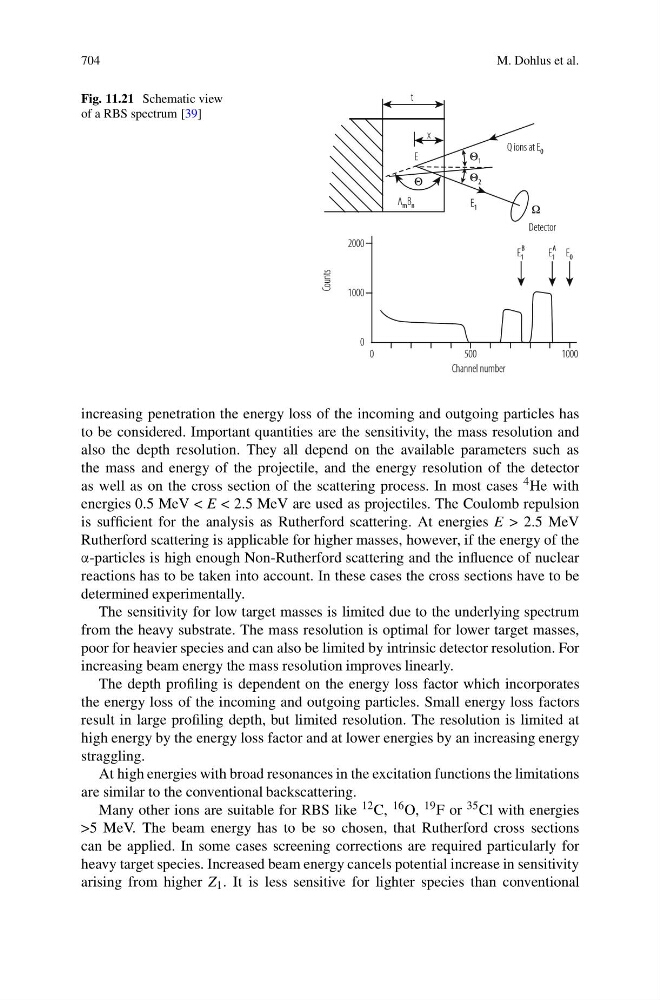
Fig. 11.21 Schematic view
of a RBS spectrum [39]
increasing penetration the energy loss of the incoming and outgoing particles has
to be considered. Important quantities are the sensitivity, the mass resolution and
also the depth resolution. They all depend on the available parameters such as
the mass and energy of the projectile, and the energy resolution of the detector
as well as on the cross section of the scattering process. In most cases 4 He with
energies 0.5 MeV < E < 2.5 MeV are used as projectiles. The Coulomb repulsion
is sufficient for the analysis as Rutherford scattering. At energies E > 2.5 MeV
Rutherford scattering is applicable for higher masses, however, if the energy of the
α-particles is high enough Non-Rutherford scattering and the influence of nuclear
reactions has to be taken into account. In these cases the cross sections have to be
determined experimentally.
The sensitivity for low target masses is limited due to the underlying spectrum
from the heavy substrate. The mass resolution is optimal for lower target masses,
poor for heavier species and can also be limited by intrinsic detector resolution. For
increasing beam energy the mass resolution improves linearly.
The depth profiling is dependent on the energy loss factor which incorporates
the energy loss of the incoming and outgoing particles. Small energy loss factors
result in large profiling depth, but limited resolution. The resolution is limited at
high energy by the energy loss factor and at lower energies by an increasing energy
straggling.
At high energies with broad resonances in the excitation functions the limitations
are similar to the conventional backscattering.
Many other ions are suitable for RBS like 12 C, 16 O, 19 F or 35 Cl with energies
>5 MeV. The beam energy has to be so chosen, that Rutherford cross sections
can be applied. In some cases screening corrections are required particularly for
heavy target species. Increased beam energy cancels potential increase in sensitivity
arising from higher Z 1 . It is less sensitive for lighter species than conventional