

11 Application of Accelerators and Storage Rings
693
power is
P sat ≈ ρP b ,
(11.81)
where P b the electron beam power, and ρ is the dimensionless FEL (Pierce)
parameter [21]
ρ =
λ u
4π
√
3L g0
=
π
8
I 0
I A
ˆ
K 2
γ 3
r A b k 2
u
1/3
.
(11.82)
(I 0 peak current, I A ≈ 17 kA Alfven current, A b beam cross section). For shortwavelength FELs ρ is typically of the order 10 −4 · · · 10 −3 .
FEL Gain-Function and Bandwidth
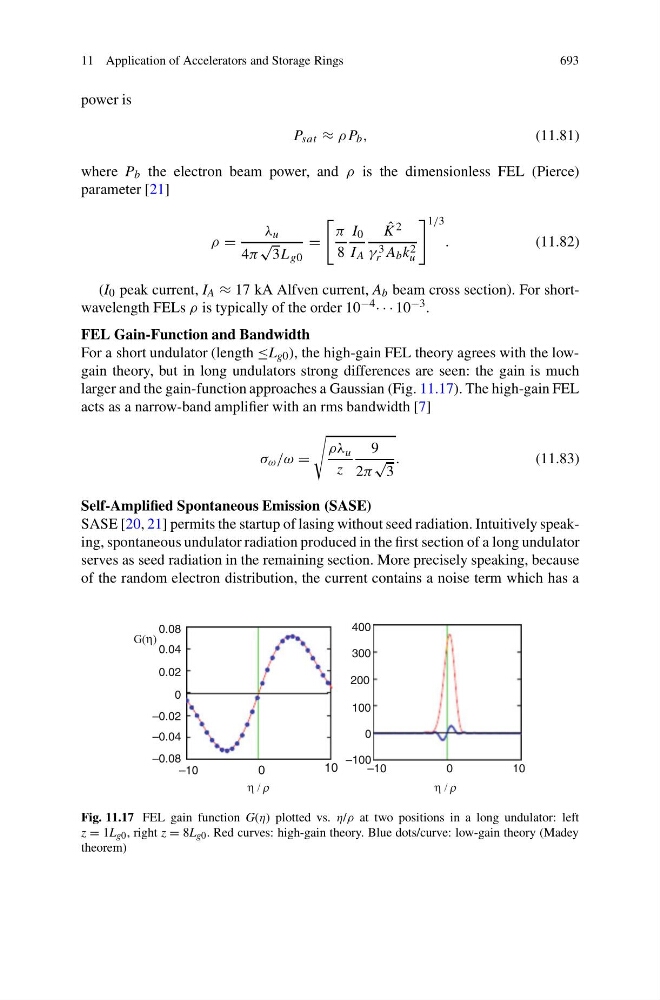
For a short undulator (length ≤L g0 ), the high-gain FEL theory agrees with the lowgain theory, but in long undulators strong differences are seen: the gain is much
larger and the gain-function approaches a Gaussian (Fig. 11.17). The high-gain FEL
acts as a narrow-band amplifier with an rms bandwidth [7]
σ ω /ω =
ρλ u
z
9
2π
√
3
.
(11.83)
Self-Amplified Spontaneous Emission (SASE)
SASE [20, 21] permits the startup of lasing without seed radiation. Intuitively speaking, spontaneous undulator radiation produced in the first section of a long undulator
serves as seed radiation in the remaining section. More precisely speaking, because
of the random electron distribution, the current contains a noise term which has a
0.08
0.04
–0.04
–0.08
–10
0
10
–10
0
10
400
300
200
100
0
–100
0.02
–0.02
0
η
η ρ
η ρ
Fig. 11.17 FEL gain function G(η) plotted vs. η/ρ at two positions in a long undulator: left
z = 1L g0 , right z = 8L g0 . Red curves: high-gain theory. Blue dots/curve: low-gain theory (Madey
theorem)