

11 Application of Accelerators and Storage Rings
663
be emitted from the charge’s position in order to reach the observer at time t. This
latter fact is actually the origin for many peculiarities of synchrotron radiation.
The electric and magnetic fields are derived from Eq. (11.1) using
γ 2 = 1/(1 − β 2 ),
− →
E = −∇φ − ∂
− →
A /∂t and
− →
B = ∇ ×
− →
A :
− →
E (0, t) =
q
4πε 0
− → n −
− →
β
γ 2
1− − → n ·
− →
β
3
R 2
t −R/c
+
q
4πε 0 c
⎡
⎣
− → n ×
− → n −
− →
β
×
˙
− →
β
1− − → n ·
− →
β
3
R
⎤
⎦
t −R/c
.
(11.2)
and
− →
B =
1
c
− → n ×
− →
E
t −R/c
.
(11.3)
While Eqs. (11.2) and (11.3) are well suited to calculate quantitatively the field
of a charge moving on a well-known path, some general properties of the field are
more conveniently determined from the equivalent expression Eq. (11.4) given in
[2]:
− →
E (0, t) =
q
4πε 0
− → n
R 2 +
R
c
d
dt
− → n
R 2
+
1
c 2
d 2
dt 2
− → n
.
(11.4)
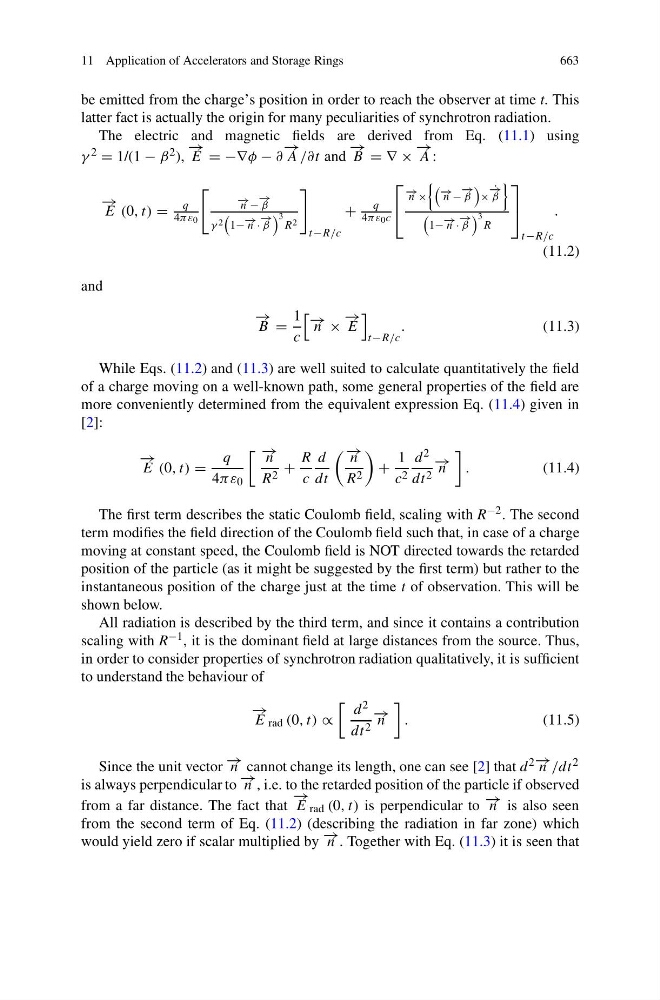
The first term describes the static Coulomb field, scaling with R −2 . The second
term modifies the field direction of the Coulomb field such that, in case of a charge
moving at constant speed, the Coulomb field is NOT directed towards the retarded
position of the particle (as it might be suggested by the first term) but rather to the
instantaneous position of the charge just at the time t of observation. This will be
shown below.
All radiation is described by the third term, and since it contains a contribution
scaling with R −1 , it is the dominant field at large distances from the source. Thus,
in order to consider properties of synchrotron radiation qualitatively, it is sufficient
to understand the behaviour of
− →
E rad (0, t) ∝
d 2
dt 2
− → n
.
(11.5)
Since the unit vector − → n cannot change its length, one can see [2] that d 2− → n /dt 2
is always perpendicular to − → n , i.e. to the retarded position of the particle if observed
from a far distance. The fact that
− →
E rad (0, t) is perpendicular to − → n is also seen
from the second term of Eq. (11.2) (describing the radiation in far zone) which
would yield zero if scalar multiplied by − → n . Together with Eq. (11.3) it is seen that