

662
M. Dohlus et al.
speed: The radiation becomes very powerful and tightly collimated in space, and
it may easily cover a rather wide spectrum ranging from the THz into the hard Xray regime. When generation of such radiation is intended rather than being a side
effect, the charged particles are normally electrons, thus kinetic energies are then
typically in the multi-MeV range.
The theoretical treatment of synchrotron radiation starts traditionally from
retarded Lienard-Wiechert potentials [1], allowing quantitative determination of
radiation properties in detail:
φ (0, t) =
q
4πε 0
1
R
1− − → n ·
− →
β
t =t −R/c
,
− →
A (0, t) =
q
4πε 0 c
− →
β
R
1− − → n ·
− →
β
t =t −R/c
.
(11.1)
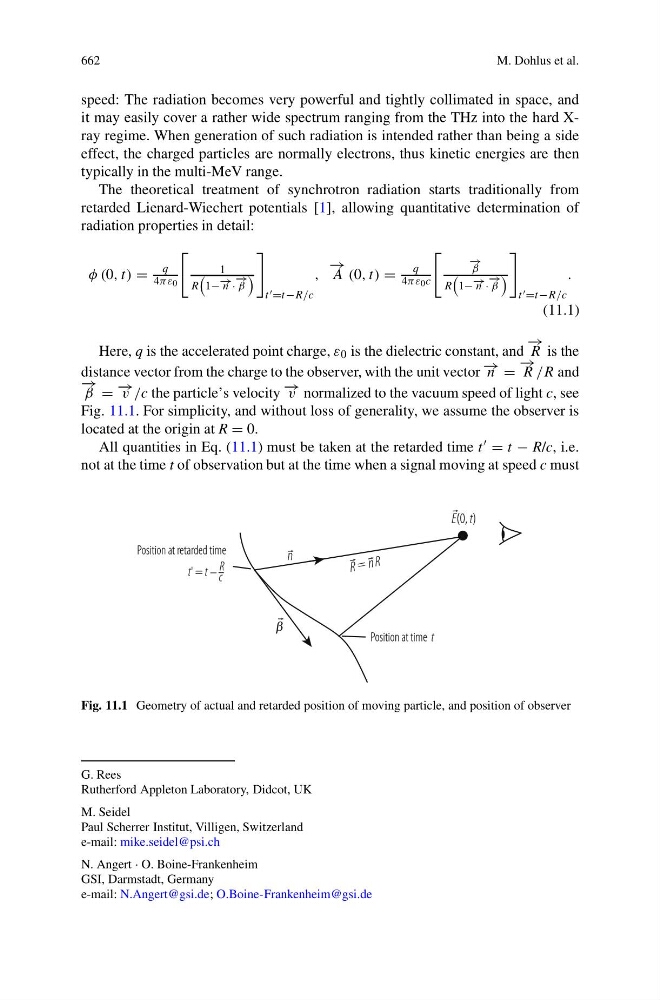
Here, q is the accelerated point charge, ε 0 is the dielectric constant, and
− →
R is the
distance vector from the charge to the observer, with the unit vector − → n =
− →
R /R and
− →
β = − → v /c the particle’s velocity − → v normalized to the vacuum speed of light c, see
Fig. 11.1. For simplicity, and without loss of generality, we assume the observer is
located at the origin at R = 0.
All quantities in Eq. (11.1) must be taken at the retarded time t = t − R/c, i.e.
not at the time t of observation but at the time when a signal moving at speed c must
Fig. 11.1 Geometry of actual and retarded position of moving particle, and position of observer
G. Rees
Rutherford Appleton Laboratory, Didcot, UK
M. Seidel
Paul Scherrer Institut, Villigen, Switzerland
e-mail: mike.seidel@psi.ch
N. Angert · O. Boine-Frankenheim
GSI, Darmstadt, Germany
e-mail: N.Angert@gsi.de; O.Boine-Frankenheim@gsi.de