

10 The Largest Accelerators and Colliders of Their Time
611
10.3.3 Electron Positron Circular Colliders
In the late 1950s the accelerator community realized that colliding beams head-on
would increase the center of mass energy significantly over fixed target collisions
and could significantly expand the reach for new particles and physics. The goal
was to design an accelerator that could provide enough centre of mass energy to
make new physics, high enough beam currents and small enough collision spot sizes
to provide a sufficient data rate, and to provide a volume for the particle physics
detector surrounding the collision point with backgrounds sufficiently low to allow
clean data collection. A world wide effort was initiated to design these accelerators
and has continued to today [86–88]. At least 25 electron-electron or electronpositron colliders have been built and operated for particle physics over the past
50 years with ever increasing beam currents, luminosity, energy, and sophistication.
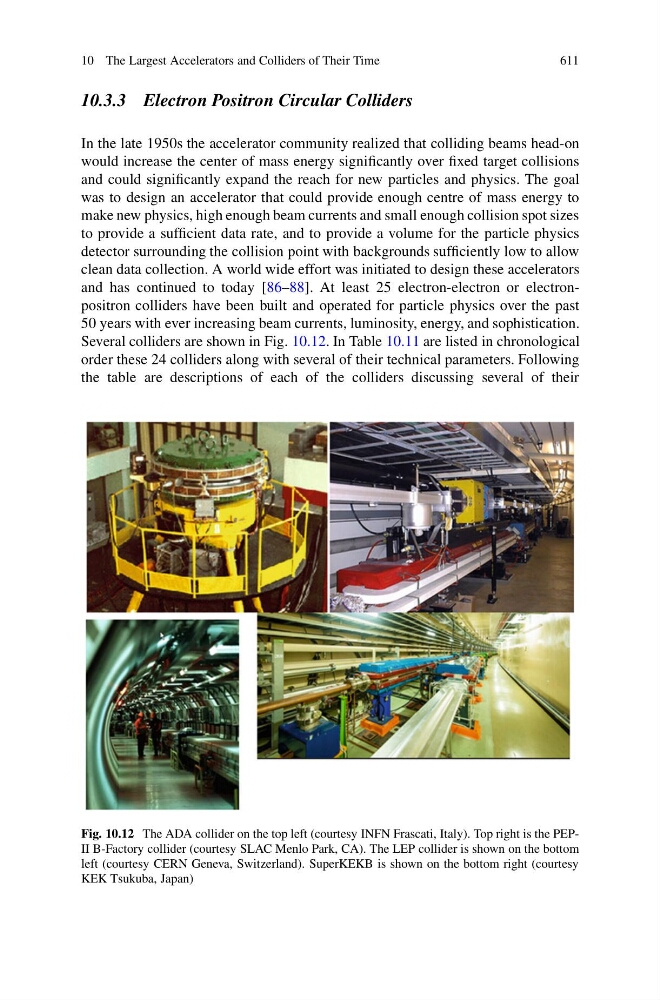
Several colliders are shown in Fig. 10.12. In Table 10.11 are listed in chronological
order these 24 colliders along with several of their technical parameters. Following
the table are descriptions of each of the colliders discussing several of their
Fig. 10.12 The ADA collider on the top left (courtesy INFN Frascati, Italy). Top right is the PEPII B-Factory collider (courtesy SLAC Menlo Park, CA). The LEP collider is shown on the bottom
left (courtesy CERN Geneva, Switzerland). SuperKEKB is shown on the bottom right (courtesy
KEK Tsukuba, Japan)