

610
K. Hübner et al.
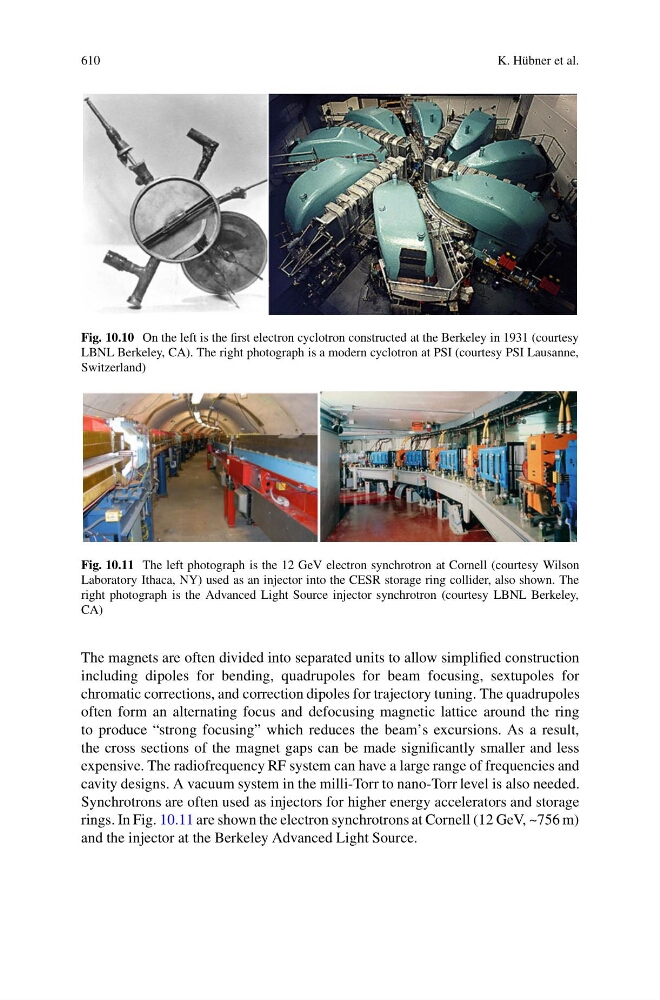
Fig. 10.10 On the left is the first electron cyclotron constructed at the Berkeley in 1931 (courtesy
LBNL Berkeley, CA). The right photograph is a modern cyclotron at PSI (courtesy PSI Lausanne,
Switzerland)
Fig. 10.11 The left photograph is the 12 GeV electron synchrotron at Cornell (courtesy Wilson
Laboratory Ithaca, NY) used as an injector into the CESR storage ring collider, also shown. The
right photograph is the Advanced Light Source injector synchrotron (courtesy LBNL Berkeley,
CA)
The magnets are often divided into separated units to allow simplified construction
including dipoles for bending, quadrupoles for beam focusing, sextupoles for
chromatic corrections, and correction dipoles for trajectory tuning. The quadrupoles
often form an alternating focus and defocusing magnetic lattice around the ring
to produce “strong focusing” which reduces the beam’s excursions. As a result,
the cross sections of the magnet gaps can be made significantly smaller and less
expensive. The radiofrequency RF system can have a large range of frequencies and
cavity designs. A vacuum system in the milli-Torr to nano-Torr level is also needed.
Synchrotrons are often used as injectors for higher energy accelerators and storage
rings. In Fig. 10.11 are shown the electron synchrotrons at Cornell (12 GeV, ~756 m)
and the injector at the Berkeley Advanced Light Source.