

10 The Largest Accelerators and Colliders of Their Time
601
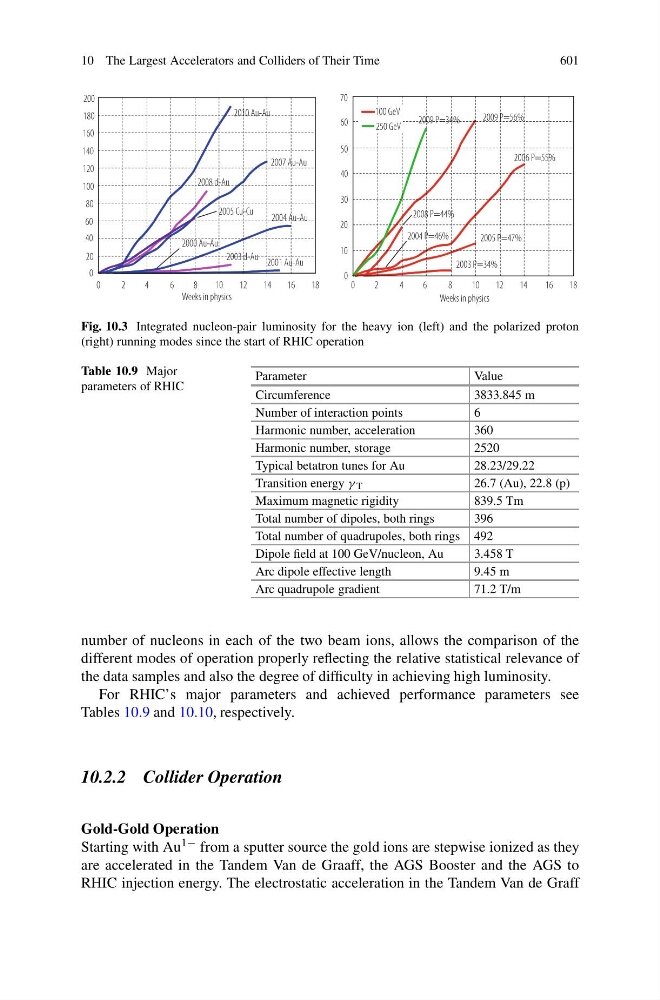
Fig. 10.3 Integrated nucleon-pair luminosity for the heavy ion (left) and the polarized proton
(right) running modes since the start of RHIC operation
Table 10.9 Major
parameters of RHIC
Parameter
Value
Circumference
3833.845 m
Number of interaction points
6
Harmonic number, acceleration
360
Harmonic number, storage
2520
Typical betatron tunes for Au
28.23/29.22
Transition energy γ T
26.7 (Au), 22.8 (p)
Maximum magnetic rigidity
839.5 Tm
Total number of dipoles, both rings
396
Total number of quadrupoles, both rings 492
Dipole field at 100 GeV/nucleon, Au
3.458 T
Arc dipole effective length
9.45 m
Arc quadrupole gradient
71.2 T/m
number of nucleons in each of the two beam ions, allows the comparison of the
different modes of operation properly reflecting the relative statistical relevance of
the data samples and also the degree of difficulty in achieving high luminosity.
For RHIC’s major parameters and achieved performance parameters see
Tables 10.9 and 10.10, respectively.
10.2.2 Collider Operation
Gold-Gold Operation
Starting with Au 1− from a sputter source the gold ions are stepwise ionized as they
are accelerated in the Tandem Van de Graaff, the AGS Booster and the AGS to
RHIC injection energy. The electrostatic acceleration in the Tandem Van de Graff