

600
K. Hübner et al.
The RHIC polarized proton collider has opened up the completely unique physics
opportunities of studying spin effects in hadronic reactions at high-luminosity
high-energy proton-proton collisions. It allows the study of the spin structure of
the proton, in particular the degree of polarization of the gluons and anti-quarks,
and also verification of the many well-documented expectations of spin effects in
perturbative QCD and parity violation in W and Z production. The RHIC center-ofmass energy range of 200–500 GeV is ideal in the sense that it is high enough for
perturbative QCD to be applicable and low enough so that the typical momentum
fraction of the valence quarks is about 0.1 or larger. This guarantees significant
levels of parton polarization.
During its 10 years of operation RHIC has greatly exceeded the design parameters for gold-gold collisions, has successfully operated in an asymmetric mode
of colliding deuteron on gold with both beams at the same energy per nucleon,
and thereby at different rigidities, and successfully completed a comparison run of
colliding copper beams with record luminosities. Operation at unequal rigidities of
the two colliding beams is a unique feature of RHIC with its two independent rings.
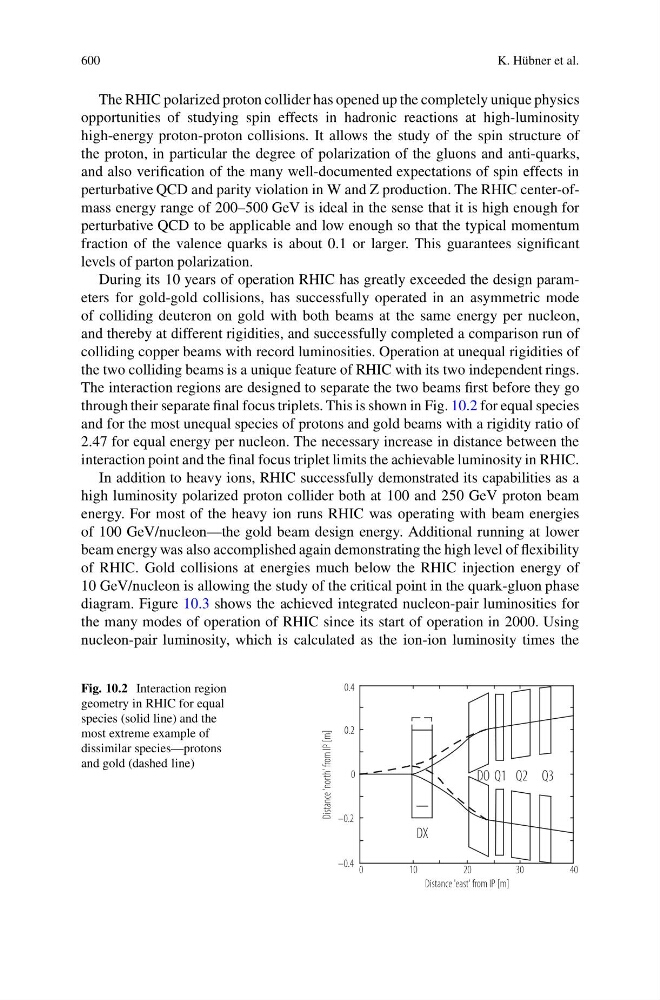
The interaction regions are designed to separate the two beams first before they go
through their separate final focus triplets. This is shown in Fig. 10.2 for equal species
and for the most unequal species of protons and gold beams with a rigidity ratio of
2.47 for equal energy per nucleon. The necessary increase in distance between the
interaction point and the final focus triplet limits the achievable luminosity in RHIC.
In addition to heavy ions, RHIC successfully demonstrated its capabilities as a
high luminosity polarized proton collider both at 100 and 250 GeV proton beam
energy. For most of the heavy ion runs RHIC was operating with beam energies
of 100 GeV/nucleon—the gold beam design energy. Additional running at lower
beam energy was also accomplished again demonstrating the high level of flexibility
of RHIC. Gold collisions at energies much below the RHIC injection energy of
10 GeV/nucleon is allowing the study of the critical point in the quark-gluon phase
diagram. Figure 10.3 shows the achieved integrated nucleon-pair luminosities for
the many modes of operation of RHIC since its start of operation in 2000. Using
nucleon-pair luminosity, which is calculated as the ion-ion luminosity times the
Fig. 10.2 Interaction region
geometry in RHIC for equal
species (solid line) and the
most extreme example of
dissimilar species—protons
and gold (dashed line)