

10 The Largest Accelerators and Colliders of Their Time
597
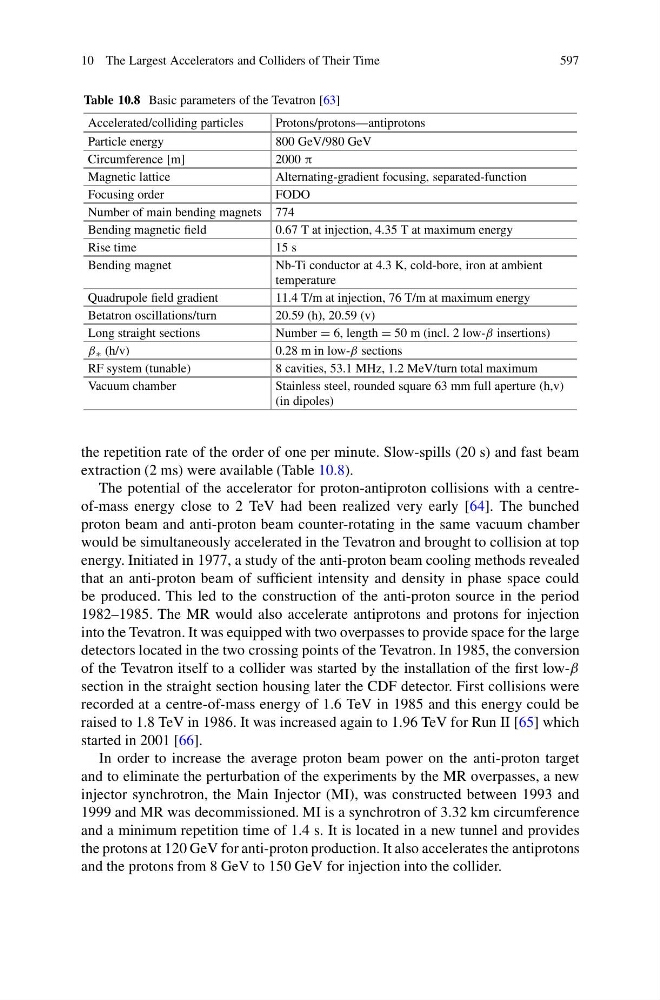
Table 10.8 Basic parameters of the Tevatron [63]
Accelerated/colliding particles
Protons/protons—antiprotons
Particle energy
800 GeV/980 GeV
Circumference [m]
2000 π
Magnetic lattice
Alternating-gradient focusing, separated-function
Focusing order
FODO
Number of main bending magnets 774
Bending magnetic field
0.67 T at injection, 4.35 T at maximum energy
Rise time
15 s
Bending magnet
Nb-Ti conductor at 4.3 K, cold-bore, iron at ambient
temperature
Quadrupole field gradient
11.4 T/m at injection, 76 T/m at maximum energy
Betatron oscillations/turn
20.59 (h), 20.59 (v)
Long straight sections
Number = 6, length = 50 m (incl. 2 low-β insertions)
β ∗ (h/v)
0.28 m in low-β sections
RF system (tunable)
8 cavities, 53.1 MHz, 1.2 MeV/turn total maximum
Vacuum chamber
Stainless steel, rounded square 63 mm full aperture (h,v)
(in dipoles)
the repetition rate of the order of one per minute. Slow-spills (20 s) and fast beam
extraction (2 ms) were available (Table 10.8).
The potential of the accelerator for proton-antiproton collisions with a centreof-mass energy close to 2 TeV had been realized very early [64]. The bunched
proton beam and anti-proton beam counter-rotating in the same vacuum chamber
would be simultaneously accelerated in the Tevatron and brought to collision at top
energy. Initiated in 1977, a study of the anti-proton beam cooling methods revealed
that an anti-proton beam of sufficient intensity and density in phase space could
be produced. This led to the construction of the anti-proton source in the period
1982–1985. The MR would also accelerate antiprotons and protons for injection
into the Tevatron. It was equipped with two overpasses to provide space for the large
detectors located in the two crossing points of the Tevatron. In 1985, the conversion
of the Tevatron itself to a collider was started by the installation of the first low-β
section in the straight section housing later the CDF detector. First collisions were
recorded at a centre-of-mass energy of 1.6 TeV in 1985 and this energy could be
raised to 1.8 TeV in 1986. It was increased again to 1.96 TeV for Run II [65] which
started in 2001 [66].
In order to increase the average proton beam power on the anti-proton target
and to eliminate the perturbation of the experiments by the MR overpasses, a new
injector synchrotron, the Main Injector (MI), was constructed between 1993 and
1999 and MR was decommissioned. MI is a synchrotron of 3.32 km circumference
and a minimum repetition time of 1.4 s. It is located in a new tunnel and provides
the protons at 120 GeV for anti-proton production. It also accelerates the antiprotons
and the protons from 8 GeV to 150 GeV for injection into the collider.