

10 The Largest Accelerators and Colliders of Their Time
595
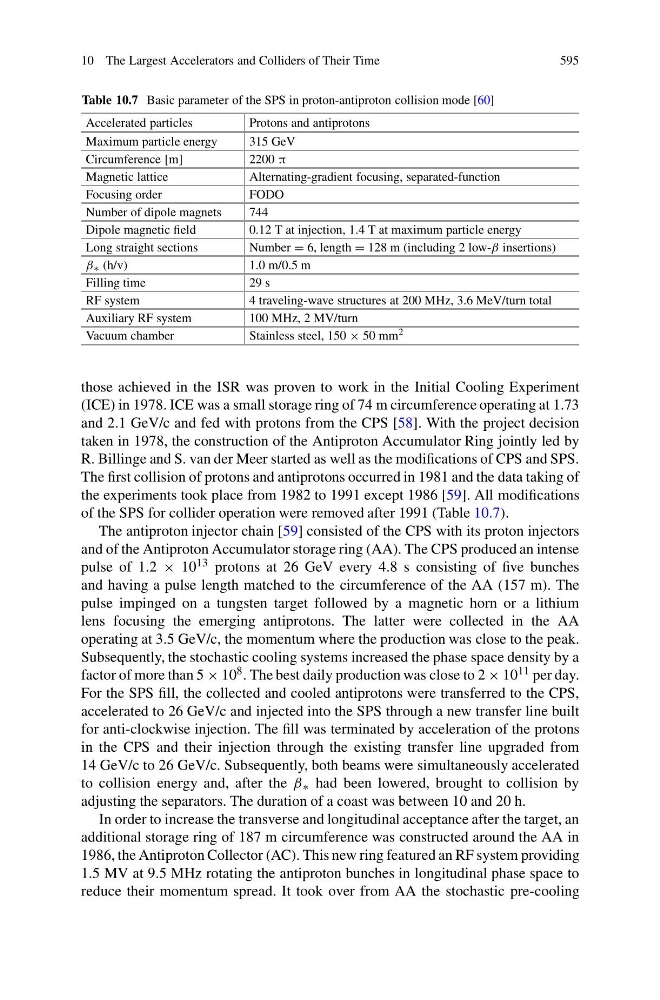
Table 10.7 Basic parameter of the SPS in proton-antiproton collision mode [60]
Accelerated particles
Protons and antiprotons
Maximum particle energy
315 GeV
Circumference [m]
2200 π
Magnetic lattice
Alternating-gradient focusing, separated-function
Focusing order
FODO
Number of dipole magnets
744
Dipole magnetic field
0.12 T at injection, 1.4 T at maximum particle energy
Long straight sections
Number = 6, length = 128 m (including 2 low-β insertions)
β ∗ (h/v)
1.0 m/0.5 m
Filling time
29 s
RF system
4 traveling-wave structures at 200 MHz, 3.6 MeV/turn total
Auxiliary RF system
100 MHz, 2 MV/turn
Vacuum chamber
Stainless steel, 150 × 50 mm 2
those achieved in the ISR was proven to work in the Initial Cooling Experiment
(ICE) in 1978. ICE was a small storage ring of 74 m circumference operating at 1.73
and 2.1 GeV/c and fed with protons from the CPS [58]. With the project decision
taken in 1978, the construction of the Antiproton Accumulator Ring jointly led by
R. Billinge and S. van der Meer started as well as the modifications of CPS and SPS.
The first collision of protons and antiprotons occurred in 1981 and the data taking of
the experiments took place from 1982 to 1991 except 1986 [59]. All modifications
of the SPS for collider operation were removed after 1991 (Table 10.7).
The antiproton injector chain [59] consisted of the CPS with its proton injectors
and of the Antiproton Accumulator storage ring (AA). The CPS produced an intense
pulse of 1.2 × 10 13 protons at 26 GeV every 4.8 s consisting of five bunches
and having a pulse length matched to the circumference of the AA (157 m). The
pulse impinged on a tungsten target followed by a magnetic horn or a lithium
lens focusing the emerging antiprotons. The latter were collected in the AA
operating at 3.5 GeV/c, the momentum where the production was close to the peak.
Subsequently, the stochastic cooling systems increased the phase space density by a
factor of more than 5 × 10 8 . The best daily production was close to 2 × 10 11 per day.
For the SPS fill, the collected and cooled antiprotons were transferred to the CPS,
accelerated to 26 GeV/c and injected into the SPS through a new transfer line built
for anti-clockwise injection. The fill was terminated by acceleration of the protons
in the CPS and their injection through the existing transfer line upgraded from
14 GeV/c to 26 GeV/c. Subsequently, both beams were simultaneously accelerated
to collision energy and, after the β ∗ had been lowered, brought to collision by
adjusting the separators. The duration of a coast was between 10 and 20 h.
In order to increase the transverse and longitudinal acceptance after the target, an
additional storage ring of 187 m circumference was constructed around the AA in
1986, the Antiproton Collector (AC). This new ring featured an RF system providing
1.5 MV at 9.5 MHz rotating the antiproton bunches in longitudinal phase space to
reduce their momentum spread. It took over from AA the stochastic pre-cooling