

10 The Largest Accelerators and Colliders of Their Time
593
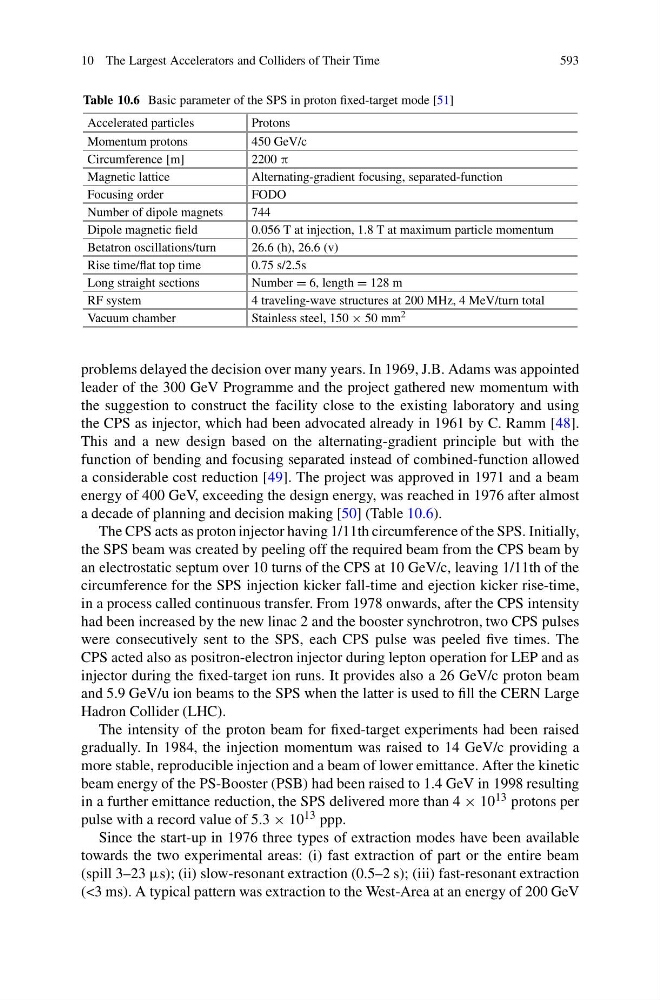
Table 10.6 Basic parameter of the SPS in proton fixed-target mode [51]
Accelerated particles
Protons
Momentum protons
450 GeV/c
Circumference [m]
2200 π
Magnetic lattice
Alternating-gradient focusing, separated-function
Focusing order
FODO
Number of dipole magnets
744
Dipole magnetic field
0.056 T at injection, 1.8 T at maximum particle momentum
Betatron oscillations/turn
26.6 (h), 26.6 (v)
Rise time/flat top time
0.75 s/2.5s
Long straight sections
Number = 6, length = 128 m
RF system
4 traveling-wave structures at 200 MHz, 4 MeV/turn total
Vacuum chamber
Stainless steel, 150 × 50 mm 2
problems delayed the decision over many years. In 1969, J.B. Adams was appointed
leader of the 300 GeV Programme and the project gathered new momentum with
the suggestion to construct the facility close to the existing laboratory and using
the CPS as injector, which had been advocated already in 1961 by C. Ramm [48].
This and a new design based on the alternating-gradient principle but with the
function of bending and focusing separated instead of combined-function allowed
a considerable cost reduction [49]. The project was approved in 1971 and a beam
energy of 400 GeV, exceeding the design energy, was reached in 1976 after almost
a decade of planning and decision making [50] (Table 10.6).
The CPS acts as proton injector having 1/11th circumference of the SPS. Initially,
the SPS beam was created by peeling off the required beam from the CPS beam by
an electrostatic septum over 10 turns of the CPS at 10 GeV/c, leaving 1/11th of the
circumference for the SPS injection kicker fall-time and ejection kicker rise-time,
in a process called continuous transfer. From 1978 onwards, after the CPS intensity
had been increased by the new linac 2 and the booster synchrotron, two CPS pulses
were consecutively sent to the SPS, each CPS pulse was peeled five times. The
CPS acted also as positron-electron injector during lepton operation for LEP and as
injector during the fixed-target ion runs. It provides also a 26 GeV/c proton beam
and 5.9 GeV/u ion beams to the SPS when the latter is used to fill the CERN Large
Hadron Collider (LHC).
The intensity of the proton beam for fixed-target experiments had been raised
gradually. In 1984, the injection momentum was raised to 14 GeV/c providing a
more stable, reproducible injection and a beam of lower emittance. After the kinetic
beam energy of the PS-Booster (PSB) had been raised to 1.4 GeV in 1998 resulting
in a further emittance reduction, the SPS delivered more than 4 × 10 13 protons per
pulse with a record value of 5.3 × 10 13 ppp.
Since the start-up in 1976 three types of extraction modes have been available
towards the two experimental areas: (i) fast extraction of part or the entire beam
(spill 3–23 μs); (ii) slow-resonant extraction (0.5–2 s); (iii) fast-resonant extraction
(<3 ms). A typical pattern was extraction to the West-Area at an energy of 200 GeV