

592
K. Hübner et al.
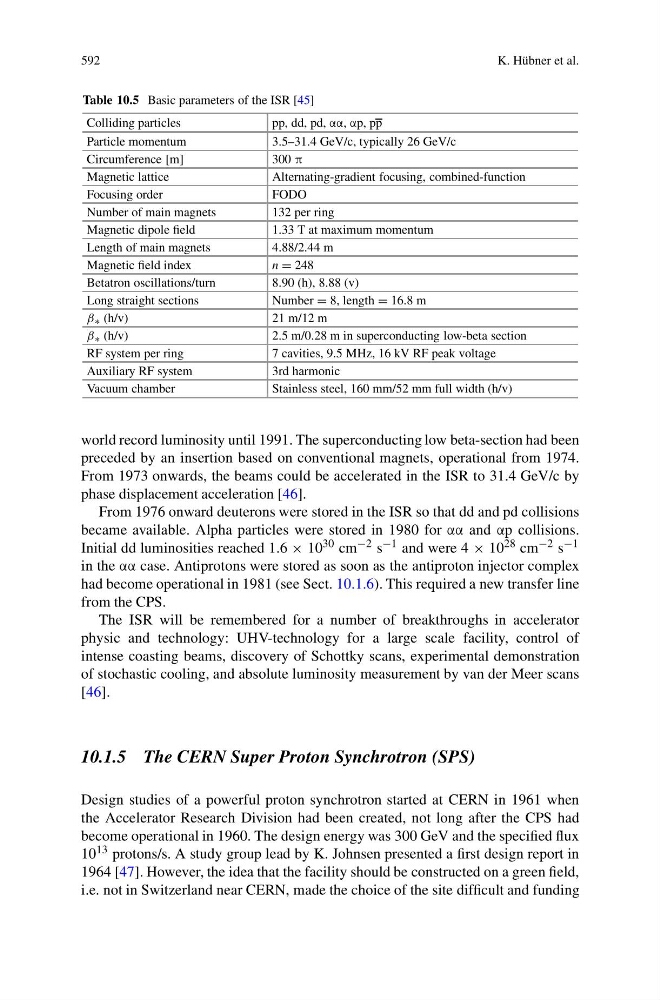
Table 10.5 Basic parameters of the ISR [45]
Colliding particles
pp, dd, pd, αα, αp, pp
Particle momentum
3.5–31.4 GeV/c, typically 26 GeV/c
Circumference [m]
300 π
Magnetic lattice
Alternating-gradient focusing, combined-function
Focusing order
FODO
Number of main magnets
132 per ring
Magnetic dipole field
1.33 T at maximum momentum
Length of main magnets
4.88/2.44 m
Magnetic field index
n = 248
Betatron oscillations/turn
8.90 (h), 8.88 (v)
Long straight sections
Number = 8, length = 16.8 m
β ∗ (h/v)
21 m/12 m
β ∗ (h/v)
2.5 m/0.28 m in superconducting low-beta section
RF system per ring
7 cavities, 9.5 MHz, 16 kV RF peak voltage
Auxiliary RF system
3rd harmonic
Vacuum chamber
Stainless steel, 160 mm/52 mm full width (h/v)
world record luminosity until 1991. The superconducting low beta-section had been
preceded by an insertion based on conventional magnets, operational from 1974.
From 1973 onwards, the beams could be accelerated in the ISR to 31.4 GeV/c by
phase displacement acceleration [46].
From 1976 onward deuterons were stored in the ISR so that dd and pd collisions
became available. Alpha particles were stored in 1980 for αα and αp collisions.
Initial dd luminosities reached 1.6 × 10 30 cm −2 s −1 and were 4 × 10 28 cm −2 s −1
in the αα case. Antiprotons were stored as soon as the antiproton injector complex
had become operational in 1981 (see Sect. 10.1.6). This required a new transfer line
from the CPS.
The ISR will be remembered for a number of breakthroughs in accelerator
physic and technology: UHV-technology for a large scale facility, control of
intense coasting beams, discovery of Schottky scans, experimental demonstration
of stochastic cooling, and absolute luminosity measurement by van der Meer scans
[46].
10.1.5 The CERN Super Proton Synchrotron (SPS)
Design studies of a powerful proton synchrotron started at CERN in 1961 when
the Accelerator Research Division had been created, not long after the CPS had
become operational in 1960. The design energy was 300 GeV and the specified flux
10 13 protons/s. A study group lead by K. Johnsen presented a first design report in
1964 [47]. However, the idea that the facility should be constructed on a green field,
i.e. not in Switzerland near CERN, made the choice of the site difficult and funding