

590
K. Hübner et al.
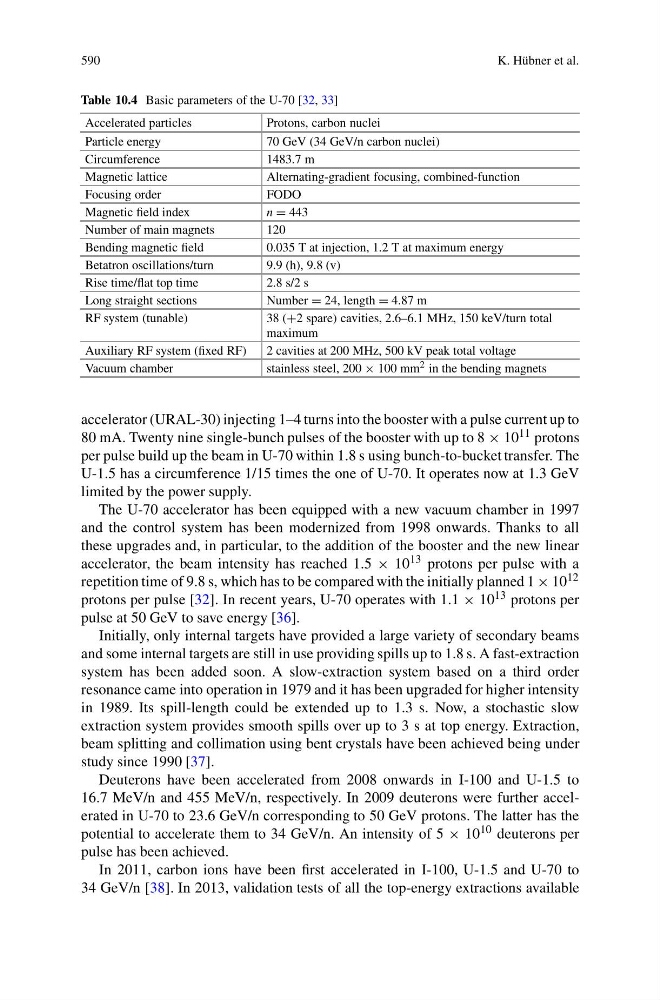
Table 10.4 Basic parameters of the U-70 [32, 33]
Accelerated particles
Protons, carbon nuclei
Particle energy
70 GeV (34 GeV/n carbon nuclei)
Circumference
1483.7 m
Magnetic lattice
Alternating-gradient focusing, combined-function
Focusing order
FODO
Magnetic field index
n = 443
Number of main magnets
120
Bending magnetic field
0.035 T at injection, 1.2 T at maximum energy
Betatron oscillations/turn
9.9 (h), 9.8 (v)
Rise time/flat top time
2.8 s/2 s
Long straight sections
Number = 24, length = 4.87 m
RF system (tunable)
38 (+2 spare) cavities, 2.6–6.1 MHz, 150 keV/turn total
maximum
Auxiliary RF system (fixed RF)
2 cavities at 200 MHz, 500 kV peak total voltage
Vacuum chamber
stainless steel, 200 × 100 mm 2 in the bending magnets
accelerator (URAL-30) injecting 1–4 turns into the booster with a pulse current up to
80 mA. Twenty nine single-bunch pulses of the booster with up to 8 × 10 11 protons
per pulse build up the beam in U-70 within 1.8 s using bunch-to-bucket transfer. The
U-1.5 has a circumference 1/15 times the one of U-70. It operates now at 1.3 GeV
limited by the power supply.
The U-70 accelerator has been equipped with a new vacuum chamber in 1997
and the control system has been modernized from 1998 onwards. Thanks to all
these upgrades and, in particular, to the addition of the booster and the new linear
accelerator, the beam intensity has reached 1.5 × 10 13 protons per pulse with a
repetition time of 9.8 s, which has to be compared with the initially planned 1 × 10 12
protons per pulse [32]. In recent years, U-70 operates with 1.1 × 10 13 protons per
pulse at 50 GeV to save energy [36].
Initially, only internal targets have provided a large variety of secondary beams
and some internal targets are still in use providing spills up to 1.8 s. A fast-extraction
system has been added soon. A slow-extraction system based on a third order
resonance came into operation in 1979 and it has been upgraded for higher intensity
in 1989. Its spill-length could be extended up to 1.3 s. Now, a stochastic slow
extraction system provides smooth spills over up to 3 s at top energy. Extraction,
beam splitting and collimation using bent crystals have been achieved being under
study since 1990 [37].
Deuterons have been accelerated from 2008 onwards in I-100 and U-1.5 to
16.7 MeV/n and 455 MeV/n, respectively. In 2009 deuterons were further accelerated in U-70 to 23.6 GeV/n corresponding to 50 GeV protons. The latter has the
potential to accelerate them to 34 GeV/n. An intensity of 5 × 10 10 deuterons per
pulse has been achieved.
In 2011, carbon ions have been first accelerated in I-100, U-1.5 and U-70 to
34 GeV/n [38]. In 2013, validation tests of all the top-energy extractions available