

10 The Largest Accelerators and Colliders of Their Time
589
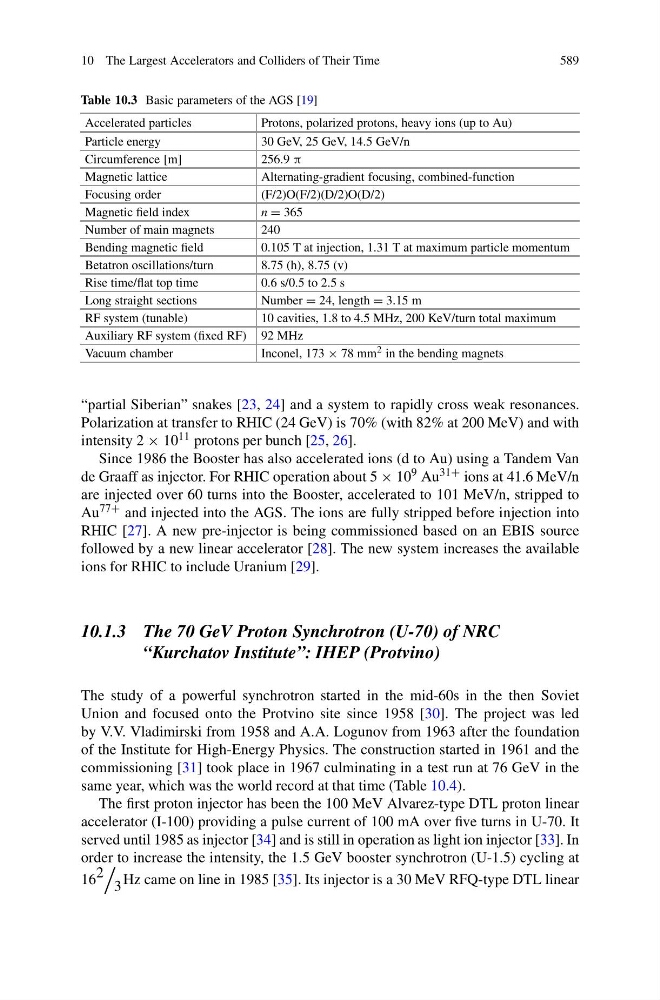
Table 10.3 Basic parameters of the AGS [19]
Accelerated particles
Protons, polarized protons, heavy ions (up to Au)
Particle energy
30 GeV, 25 GeV, 14.5 GeV/n
Circumference [m]
256.9 π
Magnetic lattice
Alternating-gradient focusing, combined-function
Focusing order
(F/2)O(F/2)(D/2)O(D/2)
Magnetic field index
n = 365
Number of main magnets
240
Bending magnetic field
0.105 T at injection, 1.31 T at maximum particle momentum
Betatron oscillations/turn
8.75 (h), 8.75 (v)
Rise time/flat top time
0.6 s/0.5 to 2.5 s
Long straight sections
Number = 24, length = 3.15 m
RF system (tunable)
10 cavities, 1.8 to 4.5 MHz, 200 KeV/turn total maximum
Auxiliary RF system (fixed RF) 92 MHz
Vacuum chamber
Inconel, 173 × 78 mm 2 in the bending magnets
“partial Siberian” snakes [23, 24] and a system to rapidly cross weak resonances.
Polarization at transfer to RHIC (24 GeV) is 70% (with 82% at 200 MeV) and with
intensity 2 × 10 11 protons per bunch [25, 26].
Since 1986 the Booster has also accelerated ions (d to Au) using a Tandem Van
de Graaff as injector. For RHIC operation about 5 × 10 9 Au 31+ ions at 41.6 MeV/n
are injected over 60 turns into the Booster, accelerated to 101 MeV/n, stripped to
Au 77+ and injected into the AGS. The ions are fully stripped before injection into
RHIC [27]. A new pre-injector is being commissioned based on an EBIS source
followed by a new linear accelerator [28]. The new system increases the available
ions for RHIC to include Uranium [29].
10.1.3 The 70 GeV Proton Synchrotron (U-70) of NRC
“Kurchatov Institute”: IHEP (Protvino)
The study of a powerful synchrotron started in the mid-60s in the then Soviet
Union and focused onto the Protvino site since 1958 [30]. The project was led
by V.V. Vladimirski from 1958 and A.A. Logunov from 1963 after the foundation
of the Institute for High-Energy Physics. The construction started in 1961 and the
commissioning [31] took place in 1967 culminating in a test run at 76 GeV in the
same year, which was the world record at that time (Table 10.4).
The first proton injector has been the 100 MeV Alvarez-type DTL proton linear
accelerator (I-100) providing a pulse current of 100 mA over five turns in U-70. It
served until 1985 as injector [34] and is still in operation as light ion injector [33]. In
order to increase the intensity, the 1.5 GeV booster synchrotron (U-1.5) cycling at
16 2
3 Hz came on line in 1985 [35]. Its injector is a 30 MeV RFQ-type DTL linear