

2 Beam Dynamics
49
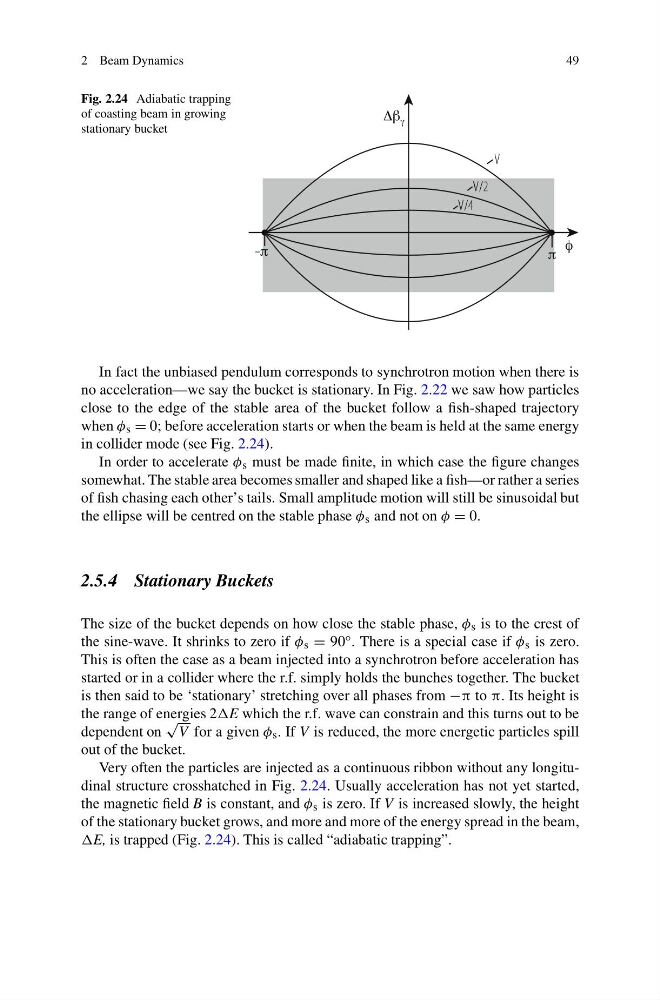
Fig. 2.24 Adiabatic trapping
of coasting beam in growing
stationary bucket
In fact the unbiased pendulum corresponds to synchrotron motion when there is
no acceleration—we say the bucket is stationary. In Fig. 2.22 we saw how particles
close to the edge of the stable area of the bucket follow a fish-shaped trajectory
when φ s = 0; before acceleration starts or when the beam is held at the same energy
in collider mode (see Fig. 2.24).
In order to accelerate φ s must be made finite, in which case the figure changes
somewhat. The stable area becomes smaller and shaped like a fish—or rather a series
of fish chasing each other’s tails. Small amplitude motion will still be sinusoidal but
the ellipse will be centred on the stable phase φ s and not on φ = 0.
2.5.4 Stationary Buckets
The size of the bucket depends on how close the stable phase, φ s is to the crest of
the sine-wave. It shrinks to zero if φ s = 90 ◦ . There is a special case if φ s is zero.
This is often the case as a beam injected into a synchrotron before acceleration has
started or in a collider where the r.f. simply holds the bunches together. The bucket
is then said to be ‘stationary’ stretching over all phases from −π to π. Its height is
the range of energies 2 which the r.f. wave can constrain and this turns out to be
dependent on
√
V for a given φ s . If V is reduced, the more energetic particles spill
out of the bucket.
Very often the particles are injected as a continuous ribbon without any longitudinal structure crosshatched in Fig. 2.24. Usually acceleration has not yet started,
the magnetic field B is constant, and φ s is zero. If V is increased slowly, the height
of the stationary bucket grows, and more and more of the energy spread in the beam,
E, is trapped (Fig. 2.24). This is called “adiabatic trapping”.
49
Fig. 2.24 Adiabatic trapping
of coasting beam in growing
stationary bucket
In fact the unbiased pendulum corresponds to synchrotron motion when there is
no acceleration—we say the bucket is stationary. In Fig. 2.22 we saw how particles
close to the edge of the stable area of the bucket follow a fish-shaped trajectory
when φ s = 0; before acceleration starts or when the beam is held at the same energy
in collider mode (see Fig. 2.24).
In order to accelerate φ s must be made finite, in which case the figure changes
somewhat. The stable area becomes smaller and shaped like a fish—or rather a series
of fish chasing each other’s tails. Small amplitude motion will still be sinusoidal but
the ellipse will be centred on the stable phase φ s and not on φ = 0.
2.5.4 Stationary Buckets
The size of the bucket depends on how close the stable phase, φ s is to the crest of
the sine-wave. It shrinks to zero if φ s = 90 ◦ . There is a special case if φ s is zero.
This is often the case as a beam injected into a synchrotron before acceleration has
started or in a collider where the r.f. simply holds the bunches together. The bucket
is then said to be ‘stationary’ stretching over all phases from −π to π. Its height is
the range of energies 2 which the r.f. wave can constrain and this turns out to be
dependent on
√
V for a given φ s . If V is reduced, the more energetic particles spill
out of the bucket.
Very often the particles are injected as a continuous ribbon without any longitudinal structure crosshatched in Fig. 2.24. Usually acceleration has not yet started,
the magnetic field B is constant, and φ s is zero. If V is increased slowly, the height
of the stationary bucket grows, and more and more of the energy spread in the beam,
E, is trapped (Fig. 2.24). This is called “adiabatic trapping”.