

9 Accelerator Operations
571
12:00
12:30
13:00
13:30
14:00
14:30
15:00
2
4
6
8
10
12
Luminosity [10
30
cm
−2
s
−1
]
Luminosity
β
∗
0.2
0.3
0.4
0.5
0.6
0.7
β
∗
[m]
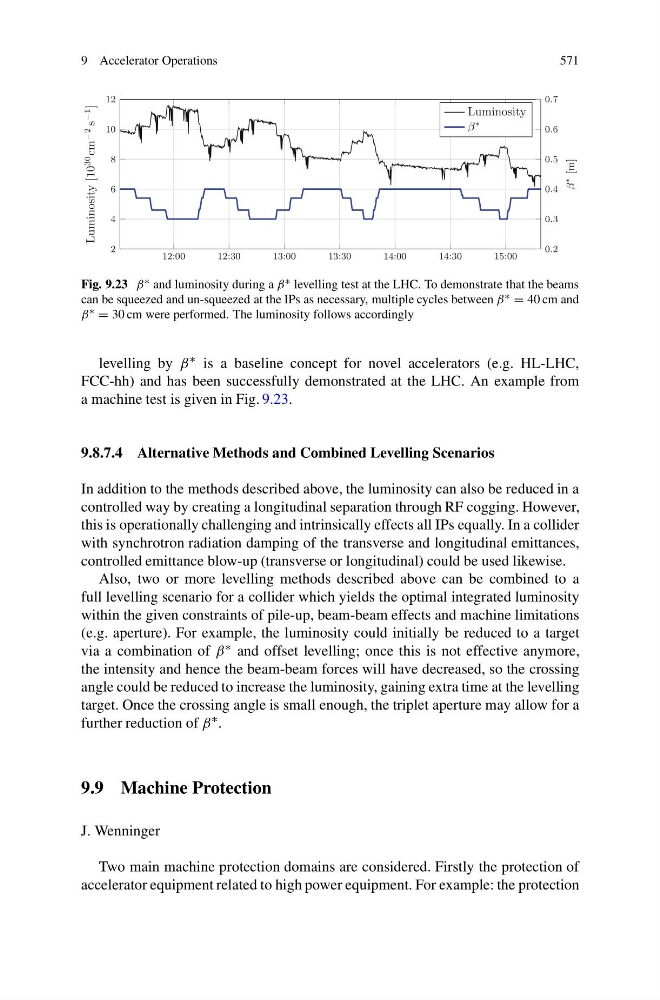
Fig. 9.23 β ∗ and luminosity during a β ∗ levelling test at the LHC. To demonstrate that the beams
can be squeezed and un-squeezed at the IPs as necessary, multiple cycles between β ∗ = 40 cm and
β ∗ = 30 cm were performed. The luminosity follows accordingly
levelling by β ∗ is a baseline concept for novel accelerators (e.g. HL-LHC,
FCC-hh) and has been successfully demonstrated at the LHC. An example from
a machine test is given in Fig. 9.23.
9.8.7.4 Alternative Methods and Combined Levelling Scenarios
In addition to the methods described above, the luminosity can also be reduced in a
controlled way by creating a longitudinal separation through RF cogging. However,
this is operationally challenging and intrinsically effects all IPs equally. In a collider
with synchrotron radiation damping of the transverse and longitudinal emittances,
controlled emittance blow-up (transverse or longitudinal) could be used likewise.
Also, two or more levelling methods described above can be combined to a
full levelling scenario for a collider which yields the optimal integrated luminosity
within the given constraints of pile-up, beam-beam effects and machine limitations
(e.g. aperture). For example, the luminosity could initially be reduced to a target
via a combination of β ∗ and offset levelling; once this is not effective anymore,
the intensity and hence the beam-beam forces will have decreased, so the crossing
angle could be reduced to increase the luminosity, gaining extra time at the levelling
target. Once the crossing angle is small enough, the triplet aperture may allow for a
further reduction of β ∗ .
9.9 Machine Protection
J. Wenninger
Two main machine protection domains are considered. Firstly the protection of
accelerator equipment related to high power equipment. For example: the protection
571
12:00
12:30
13:00
13:30
14:00
14:30
15:00
2
4
6
8
10
12
Luminosity [10
30
cm
−2
s
−1
]
Luminosity
β
∗
0.2
0.3
0.4
0.5
0.6
0.7
β
∗
[m]
Fig. 9.23 β ∗ and luminosity during a β ∗ levelling test at the LHC. To demonstrate that the beams
can be squeezed and un-squeezed at the IPs as necessary, multiple cycles between β ∗ = 40 cm and
β ∗ = 30 cm were performed. The luminosity follows accordingly
levelling by β ∗ is a baseline concept for novel accelerators (e.g. HL-LHC,
FCC-hh) and has been successfully demonstrated at the LHC. An example from
a machine test is given in Fig. 9.23.
9.8.7.4 Alternative Methods and Combined Levelling Scenarios
In addition to the methods described above, the luminosity can also be reduced in a
controlled way by creating a longitudinal separation through RF cogging. However,
this is operationally challenging and intrinsically effects all IPs equally. In a collider
with synchrotron radiation damping of the transverse and longitudinal emittances,
controlled emittance blow-up (transverse or longitudinal) could be used likewise.
Also, two or more levelling methods described above can be combined to a
full levelling scenario for a collider which yields the optimal integrated luminosity
within the given constraints of pile-up, beam-beam effects and machine limitations
(e.g. aperture). For example, the luminosity could initially be reduced to a target
via a combination of β ∗ and offset levelling; once this is not effective anymore,
the intensity and hence the beam-beam forces will have decreased, so the crossing
angle could be reduced to increase the luminosity, gaining extra time at the levelling
target. Once the crossing angle is small enough, the triplet aperture may allow for a
further reduction of β ∗ .
9.9 Machine Protection
J. Wenninger
Two main machine protection domains are considered. Firstly the protection of
accelerator equipment related to high power equipment. For example: the protection