

9 Accelerator Operations
569
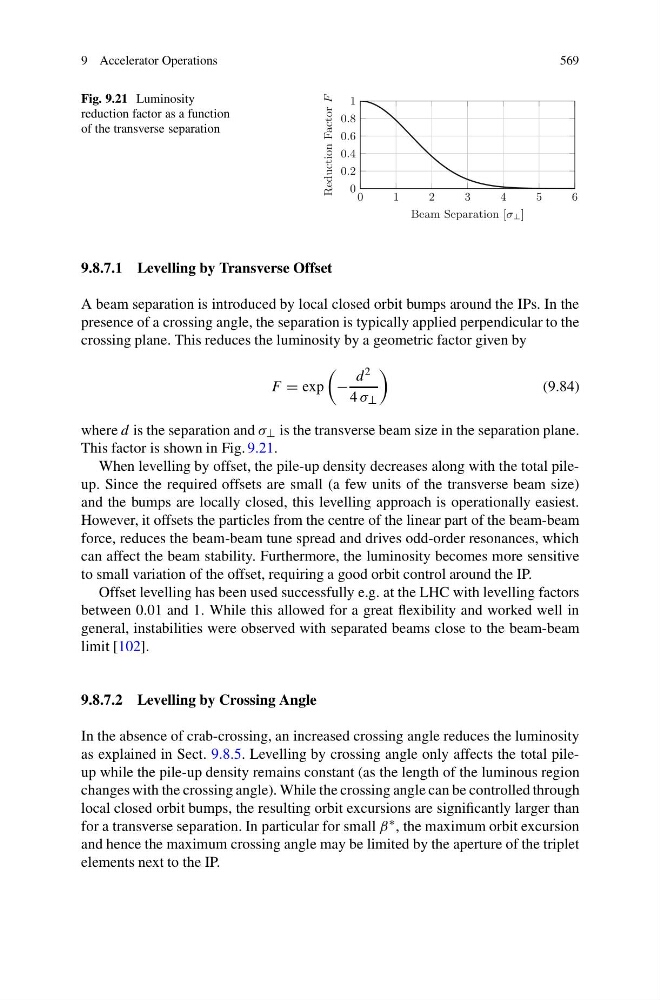
Fig. 9.21 Luminosity
reduction factor as a function
of the transverse separation
0
1
2
3
4
5
6
0
0.2
0.4
0.6
0.8
1
Beam Separation [σ⊥]
Reduction Factor
F
9.8.7.1 Levelling by Transverse Offset
A beam separation is introduced by local closed orbit bumps around the IPs. In the
presence of a crossing angle, the separation is typically applied perpendicular to the
crossing plane. This reduces the luminosity by a geometric factor given by
F = exp
−
d 2
4 σ ⊥
(9.84)
where d is the separation and σ ⊥ is the transverse beam size in the separation plane.
This factor is shown in Fig. 9.21.
When levelling by offset, the pile-up density decreases along with the total pileup. Since the required offsets are small (a few units of the transverse beam size)
and the bumps are locally closed, this levelling approach is operationally easiest.
However, it offsets the particles from the centre of the linear part of the beam-beam
force, reduces the beam-beam tune spread and drives odd-order resonances, which
can affect the beam stability. Furthermore, the luminosity becomes more sensitive
to small variation of the offset, requiring a good orbit control around the IP.
Offset levelling has been used successfully e.g. at the LHC with levelling factors
between 0.01 and 1. While this allowed for a great flexibility and worked well in
general, instabilities were observed with separated beams close to the beam-beam
limit [102].
9.8.7.2 Levelling by Crossing Angle
In the absence of crab-crossing, an increased crossing angle reduces the luminosity
as explained in Sect. 9.8.5. Levelling by crossing angle only affects the total pileup while the pile-up density remains constant (as the length of the luminous region
changes with the crossing angle). While the crossing angle can be controlled through
local closed orbit bumps, the resulting orbit excursions are significantly larger than
for a transverse separation. In particular for small β ∗ , the maximum orbit excursion
and hence the maximum crossing angle may be limited by the aperture of the triplet
elements next to the IP.
569
Fig. 9.21 Luminosity
reduction factor as a function
of the transverse separation
0
1
2
3
4
5
6
0
0.2
0.4
0.6
0.8
1
Beam Separation [σ⊥]
Reduction Factor
F
9.8.7.1 Levelling by Transverse Offset
A beam separation is introduced by local closed orbit bumps around the IPs. In the
presence of a crossing angle, the separation is typically applied perpendicular to the
crossing plane. This reduces the luminosity by a geometric factor given by
F = exp
−
d 2
4 σ ⊥
(9.84)
where d is the separation and σ ⊥ is the transverse beam size in the separation plane.
This factor is shown in Fig. 9.21.
When levelling by offset, the pile-up density decreases along with the total pileup. Since the required offsets are small (a few units of the transverse beam size)
and the bumps are locally closed, this levelling approach is operationally easiest.
However, it offsets the particles from the centre of the linear part of the beam-beam
force, reduces the beam-beam tune spread and drives odd-order resonances, which
can affect the beam stability. Furthermore, the luminosity becomes more sensitive
to small variation of the offset, requiring a good orbit control around the IP.
Offset levelling has been used successfully e.g. at the LHC with levelling factors
between 0.01 and 1. While this allowed for a great flexibility and worked well in
general, instabilities were observed with separated beams close to the beam-beam
limit [102].
9.8.7.2 Levelling by Crossing Angle
In the absence of crab-crossing, an increased crossing angle reduces the luminosity
as explained in Sect. 9.8.5. Levelling by crossing angle only affects the total pileup while the pile-up density remains constant (as the length of the luminous region
changes with the crossing angle). While the crossing angle can be controlled through
local closed orbit bumps, the resulting orbit excursions are significantly larger than
for a transverse separation. In particular for small β ∗ , the maximum orbit excursion
and hence the maximum crossing angle may be limited by the aperture of the triplet
elements next to the IP.